Most transfer students assume credits follow them automatically when transferring from college to university. They don't. One misread articulation agreement can quietly add a semester you never planned for and never budgeted.
Transfer articulation is the formal process by which a receiving institution evaluates your completed coursework and decides exactly how each course counts toward your new degree. It is not a general impression of your transcript. It is a rule-based matching system, and those rules were written long before you enrolled.
The common assumption is that counselors are the reliable safety net, and that if something goes wrong with a transfer plan, it is probably the student's fault for missing something. Most transfer students assume the process is largely automatic. Take the courses, submit the transcripts, and advisors will sort out the details.
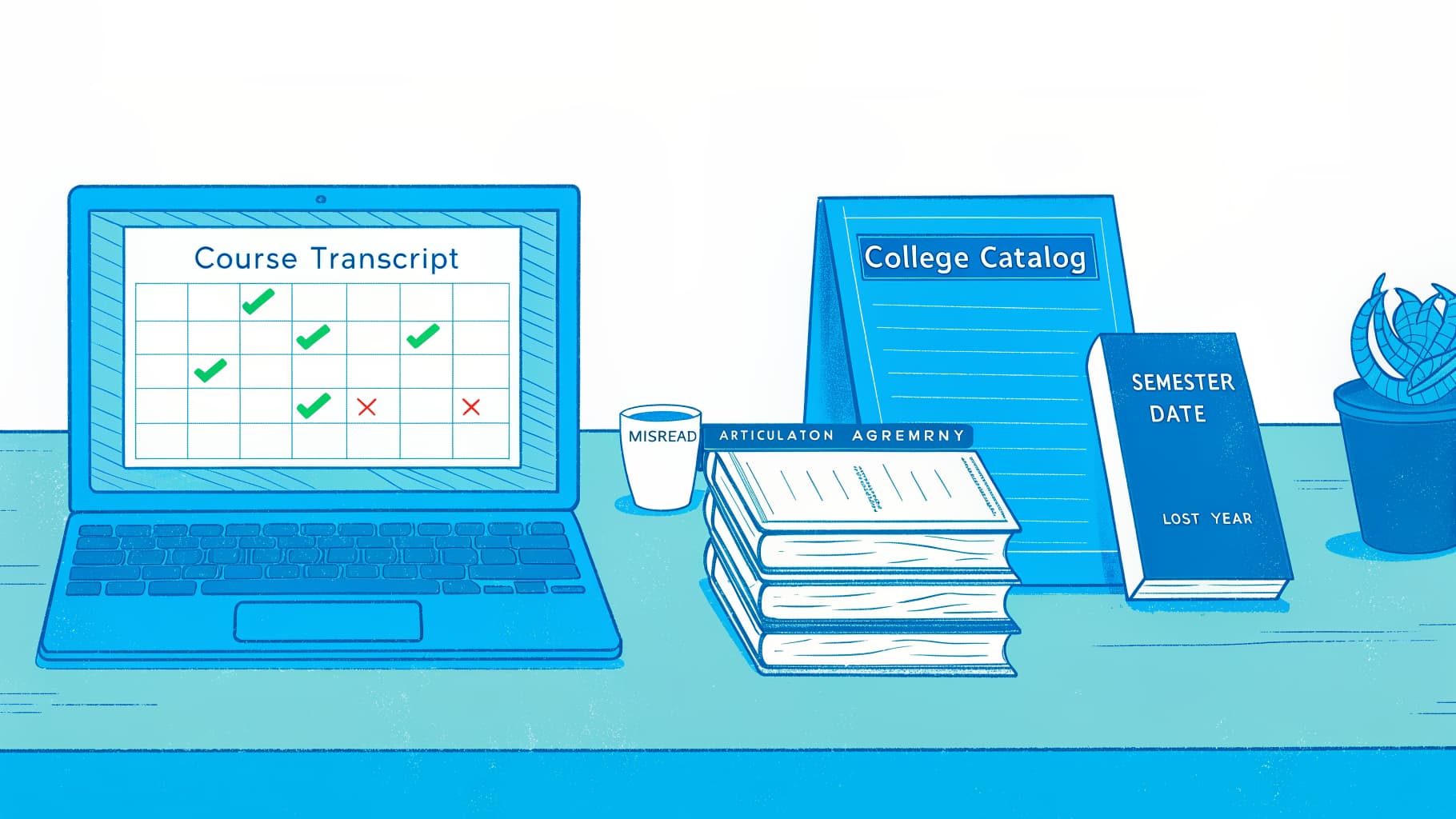
That assumption is expensive. According to a Government Accountability Office report, transfer students lose a substantial number of credits when moving between institutions, and the GAO's own findings traced the failure not to student error but to poor institutional coordination and a systemic inability to communicate transfer policies clearly to students.
Transfer articulation is the course-by-course evaluation process that determines whether credit earned at one institution satisfies a specific requirement at another. A course either matches an equivalent at the receiving school, substitutes for a requirement without being an exact match, or gets reclassified as a general elective. That third outcome is where timelines quietly collapse.
The process runs on formal articulation agreements negotiated between institutions. Students do not participate in writing those agreements, and most never read them. The result is a system that produces real consequences for individual students while being built entirely for institutional use.
Articulation agreements are written in institutional language, structured around department codes, catalog years, and major-specific tracks. A student who completes a course listed in a transfer database as "transferable" may still discover it was reclassified as a free elective because the agreement for their specific major did not include it. The database said yes.
The degree audit said no. Transfer students accumulate excess credits before completing a bachelor's degree, and each extra semester at a four-year university carries a real cost. In fact, today's baccalaureate graduates accumulate an average of 133.5 credits, well beyond the 120 typically required for a degree. Tuition at a four-year institution carries a substantial per-semester cost before fees and living expenses, meaning a single misapplied semester carries a price tag most transfer students never budgeted for.
"Students who complete coursework before deciding on a major risk taking classes that don't appear on Assist.org articulation agreements, potentially forcing them to repeat equivalent material at a different college."
133.5 Average credits earned before a bachelor's degree
Key takeaways
- Transfer articulation is a rule-based matching system, each course you completed gets evaluated against a fixed set of rules written before you ever enrolled, not a general read of your transcript.
- Articulation agreements are formal contracts between institutions, not student guides, they were built to formalize college-to-college relationships, not to hand you a verified course map.
- Nearly 40% of transfer students lose credits in the move from community college to a four-year university, and the primary driver is counselor error made mid-enrollment, often invisible until the damage is done.
- A credit appearing on your transcript is not the same as a credit doing work toward your degree, the difference between the two can cost you a full semester and thousands of dollars in tuition.
- Reading an articulation agreement yourself doesn't guarantee your credits will count, misreading one clause about course equivalency is enough to set your timeline back a year.
- Transfermatic closes that gap by building personalized transfer roadmaps that show transfer students exactly which courses count, before they register, so no credit gets wasted and no agreement gets misread.
Articulation Agreements Explained - How the Rules Are Set Before You Even Enroll
Articulation agreements are the actual rulebook for transfer credit, and they exist long before a student ever sets foot on a receiving campus. Understanding what these agreements are, how they work, and why they apply differently depending on the specific institutions involved is what separates a transfer plan that holds up from one that falls apart at the worst possible moment. The sub-sections below break down the mechanics so students and families can engage with the process from a position of clarity rather than assumption.

What an Articulation Agreement Actually Is
The common assumption is that counselors are the reliable safety net, and that if something goes wrong with a transfer plan, it's probably the student's fault for missing something. In reality, articulation agreements are formal, binding contracts between two specific institutions that define exactly which courses transfer and how those courses satisfy degree requirements. They are not general goodwill arrangements.
Each agreement is negotiated by faculty and administrators who decide, course by course, what counts and what doesn't. According to the Education Commission of the States (ECS) 2024 50-state comparison of transfer and articulation policies, the specific terms of these agreements, including which courses transfer and how they satisfy requirements, are defined through formal partnerships between individual institutions. One agreement between two colleges does not automatically extend to every student at either school.
Parents who want to catch red flags before they become expensive mistakes need to understand this distinction before the next enrollment deadline. Transfermatic surfaces it at the start of the process: within minutes of completing an intake, students and families receive a personalized semester-by-semester transfer plan built around a specific target school and major, so the formal boundaries of the applicable agreement are visible before course selection begins, not after a semester's worth of credits are already on the transcript.
Why the Same Agreement Covers Nursing but Not Business
The critical detail most students miss is that articulation agreements are almost always major-specific. A formal partnership built for nursing students defines approved prerequisites, clinical requirements, and sequencing rules for nursing. A business student at the same community college, transferring to the same university, is not covered by that agreement.
The ECS 50-state comparison confirms that a statewide policy or agreement between two colleges does not automatically extend across all majors or all receiving institutions. Students who find an agreement, assume it covers them, and enroll accordingly are the ones who end up in a registrar's office learning that a semester's worth of coursework satisfies zero major requirements. This is exactly the gap Transfermatic's Articulation Requirement Matching is built to close.
Students deciding between multiple target universities or majors can compare course equivalencies quickly across options, so a student weighing a nursing path against a health-sciences business track can see, side by side, which courses actually satisfy which requirements at which schools, before they commit. The plan is revisited each semester during course selection, and plan regeneration means a change of major or target school produces an updated roadmap rather than a silent miscalculation.
The 31-State Policy Backstop
At least 31 states have policies establishing a statewide transferable core of lower-division courses, according to the ECS 2024 data. In Illinois, this framework is formalized through the Illinois Articulation Initiative (IAI) and the Illinois Transfer Portal, which define the approved general education core that public institutions are required to accept. If you complete the approved core courses in one of those states, those credits are guaranteed to transfer to in-state public institutions. The catch is that this protection only applies if students know it exists and actively claim it.
The statewide core does not map onto every major's specific requirements. It guarantees that credits move; it does not guarantee they count toward your intended degree. For families without access to frequent, personalized counselor appointments, that distinction is rarely explained clearly enough to act on.
Transfermatic's transfer roadmap planning is most beneficial precisely in those early community college semesters, when a student has a target school and major in mind but hasn't yet learned where the statewide core ends and major-specific articulation requirements begin. Registration deadline reminders keep the timeline visible so students don't miss the enrollment windows that determine whether core-completion protection actually applies to them.
The Most Common ASSIST.org Mistake Students Make
Whether an equivalent course is required for your major, counts inside your unit cap, or falls under a current agreement year are separate questions ASSIST is not designed to answer. Research published in Research in Higher Education reinforces why this tool gap matters: navigating transfer successfully depends on students having structured, accurate, major-aligned information, not just access to raw databases. Transfermatic's Articulation Requirement Matching is designed for exactly that comparative layer: instead of asking a student to cross-reference a course-level database against a major requirements sheet against an enrollment calendar, the platform consolidates those checks.
Students deciding between multiple target universities or majors get equivalency comparisons that reflect current agreement years and unit-cap constraints, the questions ASSIST surfaces the data for but was never built to answer on its own.
Transfer Credit Policies and Limits - What Counts, What Doesn't, and What Surprises Students Most
The common assumption is that counselors are the reliable safety net, that if something goes wrong with a transfer plan, it's probably the student's fault for missing something. But a transferred credit showing up on your transcript is not the same as a transferred credit doing any work for your degree. According to a federal study cited by the Hechinger Report, nearly 40% of transfer students received no credit at all when moving to a new institution, and among those who did receive credit, 28% lost an average of 13 credits that never counted toward their degree.
3 in 10 students lose significant academic credits in the process. The gap between "credit accepted" and "credit applied" is where transfer timelines quietly fall apart. That gap hits hardest in the early semesters of community college, precisely when students have the most opportunity to course-correct.

Students who have already identified a target transfer school or a target major are the ones most positioned to prevent credit loss before it happens, because every course selection in semester one or two is still an open decision. Students who change their major or switch target schools mid-transfer face a compounded version of the same problem: courses that were on-path for one destination become elective credit at another, and those reclassifications don't surface until a registrar's audit makes them visible.
The Three Articulation Outcome Types - Equivalent, Substitution, and Elective
28% of transfer students lost 13+ credits
There are exactly three places a transferred course can land: as a direct course-to-course equivalent, as a substitution, or as general elective credit. A direct equivalent means the receiving school treats your course as an exact match for one of its own. A substitution means the course satisfies a requirement without being an exact match. Elective credit means the course adds to your total hours but satisfies nothing specific. Only the first two outcomes move your major forward. The third just makes your transcript longer.
How Course Equivalency Is Actually Determined - Content, Rigor, and Credit Hours
Course equivalencies require three things to align at once: content coverage, academic rigor, and credit hours. A course that covers similar material but runs for two credits instead of three will rarely earn a three-credit equivalent at the receiving school. A course that matches in hours but skips key content areas, say, a writing course without a research component, may land as elective credit instead of satisfying the university's composition requirement.
All three conditions have to hold together. This is where comparing multiple target schools simultaneously becomes critical, and where students deciding between two or three transfer destinations are most at risk of picking a path based on incomplete information. The same community college course may land as a direct equivalent at one university and as elective credit at another, with no visible signal in the course catalog to warn you.
Courses That Don't Transfer at All - Grade Thresholds and Non-Transferable Course Types
Courses with grades below a C are generally not accepted for transfer credit at most institutions. Beyond grades, certain course categories are typically non-transferable regardless of performance: remedial or developmental courses, vocational-technical courses tied to a specific trade credential, and college orientation or student success seminars. Internships, independent study courses, and specialized practica are evaluated case-by-case, and the honest reality is that "case-by-case" usually means "unlikely," with these credits frequently rejected outright or accepted only as elective credit.
Most students don't discover they received elective credit instead of a direct equivalent until they're sitting in an advisor's office at their new school, already enrolled. Transfermatic is built to surface that gap before enrollment. Starting within minutes of completing an initial setup, Transfermatic generates a personalized semester-by-semester transfer plan that cross-references articulation requirement matching against major-specific requirements and unit caps simultaneously, so a potential reclassification appears on a planning screen rather than in a registrar's audit.
Because the plan is revisited each semester during course selection, a student who considers changing their major or switching target schools mid-transfer can regenerate their plan against the new destination and immediately see which courses stay on-path and which ones drop to elective credit. That comparison, across multiple target universities or majors, is available before the student commits to a single additional course.
35 Transfer Articulation Resources Every Transfer Student Needs - Navigating Agreements, Databases, and Policies
Most transfer students miss the two-year completion timeline, and the primary driver is not a gap in student effort. It is a counselor error made mid-enrollment, often invisible until the damage is already done. Many transfer students lose a significant number of credits in the move from a community college to a four-year university, which can translate to an extra semester and thousands of dollars in tuition that was never part of the plan.
These losses are systemic, built into the way institutions exchange equivalency data, not the result of students failing to try hard enough. The resources below exist to help you catch those errors before they become yours. But here is what most students get wrong about this list: finding the right tool is not the hard part.
Reading it correctly is. An articulation database tells you whether a course transfers. It does not tell you whether that course satisfies your specific major requirement, whether it counts inside your unit cap, or whether the agreement it is pulling from expired last cycle.
The gap between "this course transfers" and "this course counts toward your degree" is exactly where semesters disappear. Every resource below is paired with the specific pain point it addresses, so you know not just that it exists, but precisely when to use it.
1. Transfermatic - Best All-in-One Transfer Articulation Platform
Transfermatic leads the pack for transfer students who need a single dashboard to map course equivalencies, track articulation agreements, and forecast degree completion timelines. It's the right pick for community college students planning a four-year transfer who want automated alerts when agreements change. The main tradeoff is that smaller regional colleges may not yet be fully indexed in its database.
2. Transferology - Nationwide Course Equivalency Search Engine
Transferology connects students to a broad network of participating colleges and universities, making it one of the most wide-reaching national search tools for course equivalencies. Type in a course, see where it transfers and what it becomes at the receiving school. Transferology's primary strength is its national reach: with a large number of participating institutions, it is among the broadest single search tools available for students evaluating options across multiple states or schools simultaneously. The limitation to pair with that strength: Transferology confirms course-level transfer equivalency, not whether that course satisfies a specific major or general education requirement. Using it as a first-pass survey tool, then verifying major-requirement satisfaction separately, is the right sequence.
3. ASSIST - California's Official Articulation Database
ASSIST is the authoritative source for California community college to UC and CSU transfer equivalencies, built on official agreements between institutions. It is the right first stop for any California-based student, but it is California-only, and agreements are updated on annual cycles, meaning a course that showed an equivalency last year may not carry the same designation today. Always check the agreement year displayed on the result, not just the result itself.
4. BMCC Articulation Agreements Portal - CUNY System Gateway
BMCC's dedicated articulation agreements portal gives students at Borough of Manhattan Community College a clear map of formal transfer pathways into CUNY four-year colleges and beyond. It's ideal for New York City-based transfer students who want guaranteed admission pathways with defined credit acceptance terms. The tradeoff is that agreements are institution-specific and may not reflect the most current program requirements without advisor verification.
5. Montclair State University Transfer Articulation Agreements - Advanced Degree Pathways
Montclair State's articulation agreements page stands out for its advanced degree articulation programs, including BS/MD and BS/PharmD pathways with Rutgers University and a 3+2 engineering program with Stevens Institute of Technology. It's the right resource for high-achieving transfer students targeting accelerated professional degree tracks. The limitation is that these elite pathways have strict GPA and prerequisite requirements that many transfer students may not meet.
6. Texas Common Course Numbering System (TCCNS): Statewide Transfer Equivalency Matrix
TCCNS assigns shared course numbers across Texas public colleges and universities, so a course numbered MATH 2413 at one Texas school carries the same designation at another. This is one of the cleaner statewide systems in the country for predictability. The gap: TCCNS covers common numbering, not major-specific requirement satisfaction. A course with a matching TCCNS number still needs to be verified against the specific degree plan at the receiving school.
7. CourseLeaf Commons - Institutional Course Equivalency Management Software
CourseLeaf Commons is a software platform used by registrars and articulation officers to manage common course numbering and equivalency evaluations at the institutional level. Transfer students benefit indirectly when their target school uses it, as it produces more accurate and up-to-date equivalency data. The tradeoff is that it's an administrative tool, not a student-facing resource, so students can't access it directly.
8. Blue Ridge Community College Guaranteed Admission Program - Virginia Transfer Pathway
Blue Ridge Community College's Guaranteed Admission Program offers structured transfer articulation agreements with Virginia four-year universities, providing students with a clear academic roadmap and admission guarantee upon meeting defined criteria. It's ideal for Virginia students who want certainty in their transfer outcome before completing their associate degree. The limitation is that guaranteed admission terms are GPA-dependent and program-specific.
9. AGB Transfer Pathways Framework - Governance-Level Articulation Strategy
The Association of Governing Boards' transfer pathways framework provides institutional leaders and trustees with strategic guidance on building effective transfer articulation systems. It's most valuable for administrators and policy advocates seeking to understand how governance decisions affect transfer student success. Transfer students benefit when their institutions adopt these frameworks, but the resource itself is not student-facing.
10. IGETC Certification - California General Education Transfer Curriculum
IGETC - replaced by Cal-GETC for students transferring in fall 2025 and later - is a California-specific certification that, when completed, satisfies lower-division general education requirements at most UC and CSU campuses in a single block. It is one of the most powerful tools available to California transfer students because it eliminates the need to match individual GE courses to each campus's specific requirements. The important caveat: not all UC programs accept IGETC, and some majors, particularly in engineering and the sciences, require students to complete campus-specific prerequisites instead.
11. TAG (Transfer Admission Guarantee) Programs - UC Campus-Specific Guarantees
TAG programs at six UC campuses give California community college students a guaranteed admission offer if they meet defined GPA and coursework criteria by a specific deadline. The guarantee is real, but it is campus-specific and major-specific: a TAG to UC Santa Cruz for sociology does not transfer to UC Davis or to a different major at Santa Cruz. Students who apply for TAG without confirming the exact requirements for their campus and major combination frequently find the guarantee does not apply to their actual plan.
12. Dual Admission Programs - Simultaneous Community College and University Enrollment
Dual admission programs allow students to enroll at a community college while simultaneously holding a conditional admission spot at a partnering four-year university. This transfer articulation model eliminates re-application anxiety and provides a clear academic roadmap from day one. The tradeoff is that dual admission spots are often limited in number and require students to maintain specific GPA thresholds throughout their community college tenure.
13. 2+2 Transfer Articulation Agreements - Associate to Bachelor's Degree Pathway
2+2 agreements formalize the expectation that two years at a community college plus two years at a partner four-year school produces a completed bachelor's degree. They are the structural backbone of most transfer planning. The problem students consistently run into: the 2+2 label implies a clean handoff, but the agreement only guarantees credit transfer, not that those credits will satisfy every requirement in the receiving program. Students still need to verify that their associate degree courses map to the specific major requirements at the four-year school.
14. 3+2 Accelerated Degree Articulation - Engineering and STEM Fast-Track Programs
The 3+2 articulation model, exemplified by Montclair State's partnership with Stevens Institute of Technology, allows students to earn a BS/MS in five years by splitting time between two institutions. It's ideal for high-performing STEM transfer students who want graduate-level credentials without the full six-year timeline. The tradeoff is that these programs require rigorous academic performance and careful course sequencing that leaves little room for schedule flexibility.
15. Common Application Transfer Portal - Centralized Multi-Institution Application
The Common Application's transfer portal allows students to apply to multiple four-year institutions simultaneously, streamlining the application process for transfer students navigating articulation agreements at several schools. It's best for students applying to multiple selective institutions who want to minimize administrative burden. The limitation is that not all community colleges or regional universities participate, and articulation-specific details still require direct institutional contact.
16. Statewide Articulation Matrices - Downloadable Credit Equivalency Tables
Downloadable statewide articulation matrices, like those offered through TCCNS, give transfer students a comprehensive table of course equivalencies across all participating institutions in a single document. They're ideal for students who want to do offline planning or share equivalency data with advisors. The limitation is that matrices require regular updates and may lag behind real-time changes in institutional articulation agreements.
17. Transfer Credit Evaluation Policies - Institutional Credit Acceptance Rules
Every receiving institution publishes a transfer credit evaluation policy that defines what types of credit it accepts, how many transfer credits it will apply toward a degree, and what the review process looks like. These policies are not always easy to find, but they are the governing document for every credit decision. A student who reads the articulation database but skips the transfer credit evaluation policy is missing the rules that determine whether the database result actually applies to their situation.
18. Reverse Transfer Articulation - Earning an Associate Degree After Transferring
Reverse transfer articulation allows students who transfer to a four-year school before completing their associate degree to send credits back to their community college, potentially earning the associate degree retroactively. Fewer than half of U.S. states have fully automated reverse transfer systems, meaning many students who qualify for a retroactive associate degree never receive one simply because the process requires manual initiation.
19. Transfer Pathways for Nursing Programs - Healthcare Articulation Agreements
Nursing-specific transfer articulation agreements, such as LPN-to-RN or ADN-to-BSN pathways, are among the most structured and credential-sensitive in higher education. These agreements define exactly which clinical hours, science prerequisites, and licensure exams count toward a bachelor's degree in nursing. They're essential for working healthcare professionals seeking career advancement, though clinical hour equivalency disputes remain a common friction point.
20. Prior Learning Assessment (PLA) Articulation - Credit for Work and Life Experience
Prior Learning Assessment allows transfer students to earn college credit for knowledge gained through work experience, military service, or professional certifications, supplementing traditional transfer articulation. It's particularly valuable for adult learners and veterans who have substantial real-world expertise. The limitation is that PLA credit acceptance varies widely by institution and is often capped at a maximum number of credits toward a degree.
21. Military Transfer Articulation - ACE Credit Recommendations for Veterans
The American Council on Education (ACE) publishes credit recommendations for military training and occupational experience through the Joint Services Transcript system. These recommendations are widely recognized, but acceptance is not universal. Individual institutions decide whether to accept ACE recommendations, how many credits to award, and whether those credits satisfy specific requirements or count only as general electives. Veterans who assume ACE credit recommendations translate directly into degree credit at their target school frequently discover that the receiving institution's policy is more restrictive than the recommendation suggests.
22. AP and IB Credit Articulation Policies - High School Advanced Credit Transfer
AP and IB credits are governed by each receiving institution's own scoring cutoffs and credit assignment rules, which vary widely. A score of 4 on an AP exam may earn 3 credits at one university and no credit at another, or may satisfy a requirement at one school that it does not satisfy at a comparable school. Students who earned AP or IB credit in high school should request the receiving institution's specific AP/IB credit chart before assuming those credits reduce their required coursework.
23. Guaranteed Admission Agreements (GAA): Conditional Transfer Admission Contracts
GAAs are formal contracts between a community college and a four-year institution that guarantee admission when a student meets defined academic criteria. They differ from TAG programs in that they are often bilateral agreements between specific pairs of institutions rather than systemwide programs. The condition that students most frequently miss: GAAs guarantee admission, not the application of specific credits. A student admitted under a GAA still needs to go through the credit evaluation process separately to confirm that their coursework satisfies degree requirements.
24. Transfer Articulation Audits - Pre-Transfer Credit Review Services
A transfer articulation audit is a pre-transfer review of your completed coursework against the requirements of your target program at your target school. Some institutions offer this service through their transfer center; others require you to request it directly from the receiving institution's admissions or registrar office. The value is in catching mismatches before you transfer, not after. Students who skip the audit and rely solely on database results are the ones who most often discover at orientation that a required course was never on their plan.
25. CUNY Transfer Explorer - New York City Transfer Articulation Tool
CUNY Transfer Explorer is a web-based tool that allows students within the City University of New York system to see exactly how their courses transfer between CUNY colleges, including which credits count toward specific degree requirements. It's indispensable for CUNY students planning intra-system transfers. The limitation is that it only covers CUNY institutions and doesn't address transfers to private or out-of-state universities.
26. Florida FACTS - Statewide Articulation and Advising Resource
Florida's FACTS system combines articulation data, degree audit tools, and financial aid information into a single statewide portal, making it one of the more comprehensive state-level resources available. Florida's statewide articulation policy is among the strongest in the country, guaranteeing transfer of a defined general education core across all public institutions. The caveat: the guarantee applies to general education, not to major prerequisites, which still need to be verified against the specific program requirements at the receiving school.
27. Ohio Transfer 36 - Guaranteed General Education Transfer Block
Ohio Transfer 36 guarantees that 36 credit hours of completed general education coursework at any Ohio public institution will transfer and be accepted as meeting general education requirements at any other Ohio public institution. It eliminates GE repeat coursework for Ohio transfer students and is one of the strongest statewide transfer articulation protections in the country. The limitation is that it doesn't cover major-specific or upper-division course requirements.
28. North Carolina Comprehensive Articulation Agreement (CAA): Community College to UNC System
North Carolina's CAA is one of the most detailed statewide articulation agreements in the country, covering the transfer of the Associate in Arts and Associate in Science degrees from North Carolina community colleges to UNC system universities. Students who complete the AA or AS under the CAA are guaranteed junior standing at any UNC institution. The limitation: the CAA covers general education and elective credits within the associate degree framework. Students still need to confirm that their major prerequisites align with the specific program requirements at their target UNC campus.
29. Virginia Community College System (VCCS) Transfer Pathways - Guaranteed Admission to Virginia Four-Year Schools
VCCS transfer pathways provide Virginia community college students with structured articulation agreements and guaranteed admission to Virginia public four-year universities when academic criteria are met. The system includes major-specific transfer guides that map community college coursework to university degree requirements. The limitation is that guaranteed admission terms vary by receiving institution and program, requiring students to verify specific pathway requirements.
30. Transfer Articulation Agreements for Business Programs - Accounting and Finance Pathways
Business-specific transfer articulation agreements define how community college accounting, finance, and management courses map to AACSB-accredited business school requirements at four-year institutions. They're critical for business transfer students who need to ensure their foundational courses satisfy accreditation-driven curriculum requirements. The tradeoff is that AACSB accreditation standards can create stricter equivalency requirements than general transfer agreements allow.
31. Transfer Articulation for Computer Science - STEM Pathway Agreements
Articulation databases show equivalencies. Transfermatic builds a verified, semester-by-semester plan that cross-references those equivalencies against your specific major requirements, unit caps, and agreement timelines simultaneously, the same multi-layer gap that research consistently identifies as the primary driver of missed two-year timelines. Transfermatic is most beneficial at two distinct moments in a student's journey.
The first is early, ideally the start of your first or second semester of community college, when you have a target school and major in mind. At that stage, Transfermatic generates a personalized semester-by-semester transfer plan, and because setup completes within minutes of finishing the intake process, students can move from "I just enrolled" to "I have a concrete roadmap" before they register for their first round of courses. That plan is not static: it is designed to be revisited each semester during course selection so it reflects any changes to agreements, requirements, or your own academic situation.
The second moment where Transfermatic is particularly useful is when you are deciding between multiple target universities or majors and need to compare course equivalencies quickly. That comparison, running the same completed or in-progress coursework against the requirement stacks of different schools simultaneously, is exactly what its Articulation Requirement Matching feature is built to do. Students planning a faster, cleaner transfer path to a top university, and parents helping their student navigate that process, use this feature to answer "which school gives me the best credit position?" before committing to an application target, rather than discovering the answer after the fact.
Beyond the core planning and matching functions, Transfermatic includes a centralized scholarship finder, RateMyProfessor integration for course selection, registration deadline reminders, and plan regeneration when your situation changes. These are not decorative features: registration deadline reminders alone address one of the most common mechanical reasons students end up off-plan, and plan regeneration means a major change or a failed prerequisite does not require rebuilding your roadmap from scratch.
The honest tradeoff: Transfermatic is purpose-built for students with a defined destination or a defined set of destinations they are actively comparing. Students who are entirely undecided on both school and major will get less precision from it until those parameters are in place.
32. Articulation Agreement Expiration Tracking - Keeping Agreements Current
Articulation agreements are not permanent. Most are renewed on two- to five-year cycles, and a course that was formally equivalent under last year's agreement may carry a different designation, or no designation at all, under the current one. The agreement cycle date is the single most overlooked piece of information in any articulation database result. Students who pull an equivalency without checking the agreement's effective dates are potentially building a plan on an expired document, which is exactly how a course ends up "transferring" without counting toward anything. Articulation Records and Guides published by receiving institutions, such as those available through the University of Nebraska Omaha's transfer services office, are the most reliable place to confirm both the current agreement version and its effective date range.
33. Transfer Articulation Workshops - On-Campus Advising Events
Transfer articulation workshops hosted by community college advising centers provide students with hands-on guidance for navigating articulation agreements, completing transfer applications, and understanding credit evaluation processes. They're the most accessible resource for first-generation transfer students who benefit from in-person guidance. The limitation is that workshop availability is often limited to specific times of year and may not address every student's unique transfer situation.
34. Transfer Articulation Databases - Searchable Institutional Agreement Repositories
Searchable transfer articulation databases aggregate formal agreements between institutions, allowing students to quickly identify which schools have active partnerships with their current college. They're the most efficient starting point for transfer research and save students hours of manual institutional website searching. The limitation is that database completeness depends on institutional participation, and some agreements may exist that aren't yet reflected in the database.
35. Transfer Articulation Scorecards - Institutional Performance Metrics
Transfer articulation scorecards are institutional reports that measure how well a college's transfer students perform at the receiving institution, how many credits they bring in, and how many they lose. They are published by state higher education agencies and accrediting bodies, and they are most useful for comparing institutions before you commit to a sending or receiving school. A school with a strong scorecard has a track record of clean credit transfer. A school with a weak scorecard is a signal to ask harder questions before you commit to their articulation agreements.
Most students who work through this list will find a resource that confirms their course transfers. Fewer will find a resource that confirms that course satisfies the right requirement, inside the right unit cap, under an agreement that is still active.
That gap is structural, not personal. The transfer system's architecture was built for institutional record-keeping, not for individual degree navigation, and that design decision is the reason spending hours in articulation databases can still leave a student blindsided at enrollment when one course satisfied the wrong requirement. Students who are in the early semesters of community college with a target school or major in mind, and parents who are helping their student plan a faster, cleaner transfer path to a top university, are the ones who benefit most from closing that gap before it compounds.
A personalized transfer roadmap that cross-references equivalency data against your specific major, your unit cap, and your agreement's expiration date simultaneously is the instrument that does that, because no single database was designed to do all three at once. Transfermatic's plan regeneration feature means that if your situation changes, a course doesn't go as planned, you shift your target school, or an agreement updates, your roadmap adjusts rather than becoming a liability. Every resource in this list gives you information, but information and certainty are not the same thing.
The next section confronts the structural reason why: the transfer system was never designed to be navigated by a student working alone, and knowing that changes how you use every tool on this page.
Related Reading
- Transferring From Community College To University
- When Is It Too Late To Transfer Colleges
- Is Community College Free In California
- Community College Transfer Mistakes
- Do Community College Credits Expire
The Real Problem Isn't the System - It's That It Was Never Meant to Be Navigated Alone
Transfer articulation agreements were designed to manage relationships between institutions, not to guide individual students through a sequence of decisions that can cost them credits, time, and money if they get it wrong. The problem most transfer students face is not a lack of information but a lack of anything that connects course equivalency, major requirements, and semester sequencing into a verified plan built around their specific situation. That gap is what this section examines, and it is the gap Transfermatic was built to close.

Transfer Articulation Wasn't Built for Individual Students
Articulation agreements exist to formalize relationships between colleges, not to hand individual students a verified course map. A federal study found that nearly 40 percent of transfer students lose credits in the process, and the primary cause is structural: agreements are built around institutional compliance, not around one student's specific major, target school, and semester sequence. A counselor can tell you a course "should" transfer.
The agreement can confirm a partnership exists. Neither one builds your plan. For parents, this creates a particular kind of anxiety: even when you want to oversee your kid's academic path, the system gives you no centralized, trustworthy way to verify that the right classes are being taken in the right order.
Students we work with describe the same feeling, a persistent second-guessing of every course registration decision because no single source has ever told them, with confidence, that their sequence is correct. That uncertainty is not a personal failure. It is what the system produces.
The Gap the 35 Resources Can't Close - Information vs. Certainty
From what we see across the students we work with, transfer students commonly accumulate excess credits before completing their degree. That is not a research failure. Those students used the databases. They read the PDFs. The problem is that no single tool connects course equivalency, major-specific requirements, GE policy, and semester sequencing into one verified picture for your exact situation. Information is available. Synthesis is not. And without synthesis, every resource you consult is just another data point you have to reconcile yourself.
Families we work with put it plainly: they want a clear, personalized plan that shows their student is doing the right classes in the right order, not a stack of PDFs they have to cross-reference themselves at midnight before registration closes.
Credit Loss Is a Structural Guarantee, Not a Student-Effort Problem
The core claim of this guide is this: credit loss is not a random misfortune or a student-effort problem, it is a structurally predictable outcome of a system where institutional coordination failures, multi-layered articulation rules, and information gaps combine to guarantee that a significant share of transfer students will lose progress regardless of how diligently they follow generic counselor advice. The Hechinger Report's federal study data makes the scale of that outcome impossible to dismiss. The only effective countermeasure is a personalized, verified plan that stress-tests every course against every relevant policy layer before enrollment.
That is what Transfermatic's Transfer Roadmap Planning is built to deliver. Within minutes of completing intake and setup, Transfermatic generates a personalized semester-by-semester transfer plan, cross-referencing articulation requirement matching, major-specific course equivalencies, and GE policy simultaneously, so that the synthesis gap is closed before you register for a single class. The plan is most powerful when a student is in the early semesters of community college with a target school and major already in mind, and it is revisited each semester during course selection.
Built-in registration deadline reminders and automatic plan regeneration mean the roadmap stays current even when institutional requirements shift, giving both students and their families a structured system they can trust between advising appointments. For students deciding between multiple target universities or majors, Transfermatic's Articulation Requirement Matching layer lets you compare course equivalencies across institutions quickly, so the plan sharpens as your direction does, rather than forcing you to commit before you are ready. To be honest: a roadmap is not a guarantee against every institutional policy change. If a receiving school updates its major requirements mid-enrollment, no pre-transfer plan can fully absorb that in real time.
What it does guarantee is that every variable knowable before you transfer has been cross-referenced before you commit, and that you can stop second-guessing every registration decision because the synthesis has already been done for you. If you are still undecided on both your major and your target school, a verified articulation plan will give you less immediate precision. The planning layer is most powerful once those two decisions are made, and students still in the exploratory phase will get more initial value from broad equivalency tools like Transferology or ASSIST before committing to a direction.
Next steps
If your coursework is on track according to a counselor but you have no way to verify that every course satisfies the right requirement at the right school under a current agreement, the path forward starts with treating that uncertainty as structural, not personal. The body of this post established that credit loss is a predictable outcome of institutional design failures, not student error, and that no single database was built to cross-reference equivalency, major requirements, and agreement expiration dates simultaneously for your specific situation. Start with our best transfer planner for community college students.
The widespread existence of statewide transferable core policies in 31 states creates a dangerous false sense of security, meaning students who rely on those backstops are statistically the most likely to skip the course-level verification that actually prevents credit loss. Counselor advice operates at the institutional level while credit loss occurs at the course-and-major level, meaning the gap between those two layers accumulates invisibly until it surfaces as a one-year delay and thousands in tuition you never budgeted for. Together, they point to building a verified, course-level plan before you register for another semester, not after.
Start with the best transfer planner for community college students to get a personalized, semester-by-semester roadmap that cross-references equivalency, major requirements, and unit caps simultaneously. Complete the intake, get your plan, and stop second-guessing every registration decision.
Frequently Asked Questions
How do I find the articulation agreement that actually applies to my major?
Articulation agreements are major-specific, so the agreement covering nursing students at your community college does not automatically cover business students transferring to the same university. Your receiving institution's registrar or transfer office is the right starting point, but the critical step is confirming the agreement is current for your catalog year and your specific major, not just your sending school.
If a course shows up as transferable in an articulation database, does that mean it counts toward my degree?
No, and this is the gap where most transfer timelines quietly fall apart. A course showing a match in a database means an equivalency agreement exists at the course level; it does not mean that course satisfies a specific major requirement, counts inside your unit cap, or falls under a current agreement year. Those are separate questions a course-level database is not designed to answer.
Are there any guaranteed protections if I complete certain courses at a community college?
At least 31 states have policies establishing a statewide transferable core of lower-division courses, which guarantees those credits transfer to in-state public institutions, but only if you know the protection exists and actively claim it. The statewide core guarantees credits move; it does not guarantee they count toward your specific major's requirements.
What actually happens to a transferred course, does it always count toward my major?
There are exactly three places a transferred course can land: as a direct equivalent, as a substitution, or as general elective credit. Only the first two outcomes move your major forward; elective credit adds to your total hours but satisfies nothing specific, which is where extra semesters and unbudgeted tuition costs accumulate.
Why do students lose credits even when they think they planned everything correctly?
According to a 2017 GAO report cited in this post, the primary cause of transfer credit loss is poor institutional coordination and a systemic inability to communicate transfer policies clearly to students, not student error. A course may be listed as transferable in a database but still get reclassified as a free elective if the articulation agreement for that specific major did not include it, a mismatch that typically doesn't surface until a registrar's audit after enrollment.