TAG promises a guaranteed UC admission, but it is a conditional contract with a checklist that voids the deal if you miss even one item. Here is what most students never see coming.
The Transfer Admission Guarantee sounds exactly like what it promises: a guaranteed path from a California community college to a UC campus, making transferring from college to university feel like a sure thing, with no nerve-wracking waitlist and no hoping your application lands on the right desk. The common assumption is: "If I meet the GPA cutoff and submit my TAG application on time, I'm covered." That framing is why so many transfer students build their entire academic plan around it.
It is also why so many of them get blindsided. The reality is more demanding than the name suggests. TAG is a conditional contract, not an open invitation, and the conditions are specific, simultaneous, and unforgiving.

Understanding what it actually requires, before you commit a single semester to it, is the difference between a clean two-year transfer and an expensive extra year you never planned for. A Transfer Admission Guarantee is a formal agreement between a California community college student and a participating UC campus. Meet every stated condition, and admission is secured.
Miss one, and the agreement is void. That means GPA thresholds, specific required courses, unit counts, and major eligibility all have to align at the same time. One student's TAG for UC Davis was revoked simply because they confirmed they were not planning to take a required course.
The university sent an email, the student replied honestly, and the guarantee disappeared within a month of submission. TAG is only available to students whose most recent institution of attendance is a California community college. Transfer students who return to community college after starting elsewhere often assume their community college enrollment resets the clock.
It does not. Last school attended is a hard filter, not a preference. The word guaranteed creates a psychological safety net that does not fully exist.
Students have been denied TAG because a counselor incorrectly identified a lower-level math course as UC-transferable, leaving them short of the required 60 UC-transferable units. Others have had admission revoked after acceptance because a major-preparation course was not completed by the stated deadline. Meeting the GPA requirement is necessary, but it is not sufficient. The guarantee is only as strong as the weakest condition in its checklist, and that checklist is longer, and less forgiving, than the name implies.
Key takeaways
- TAG is a guaranteed admission path, but only to six UC campuses, and UC Berkeley, UCLA, and UC San Diego have never been part of it.
- The guarantee is conditional on your major: restricted and excluded majors void eligibility quietly, and most students don't find out until after they've built their coursework around the wrong assumption.
- Missing the September 1-30 application window by a single day resets your timeline by a full year; there is no late submission, no appeal, and no exception.
- GPA thresholds alone don't determine eligibility; unit milestones, specific course completions, and semester sequencing all have to align before you open UC TAP in September.
- More than half of California community college students who intend to transfer don't complete the transition within two years; most planning errors happen long before the application.
- Transfermatic's semester-by-semester transfer plan maps exactly which courses to take each term so you hit every TAG milestone on schedule and don't burn credits on classes that don't move you forward.
Which UC Campuses Participate in TAG: and the Big Three That Don't
Six UC campuses participate in TAG for Fall 2026: UC Davis, UC Irvine, UC Merced, UC Riverside, UC Santa Barbara, and UC Santa Cruz. That list is official and fixed. UC Berkeley, UCLA, and UC San Diego are not on it, and they never have been. This is the synthesis point worth stating plainly: TAG is not a universal UC safety net. It is a restricted, one-shot instrument that excludes the three most competitive UC campuses and bars entry to high-demand majors at the campuses that do participate, meaning the students most likely to treat it as a backup plan (those targeting Berkeley, UCLA, or UCSD, or pursuing CS/engineering) are precisely the students for whom TAG doesn't exist.
1. Transfermatic - Best for Building a Complete TAG-Ready Transfer Roadmap
Transfermatic is the only tool that generates a personalized, semester-by-semester transfer plan built around TAG eligibility requirements, flagging exactly which courses to take, in which order, to hit GPA thresholds and major prep deadlines on time. For transfer students targeting one of the six TAG campuses, it eliminates guesswork. The tradeoff: it's a planning tool, not an admissions office, so students still submit the TAG application themselves.
2. UC Santa Cruz TAG - Best for Students Targeting Competitive STEM and Social Sciences
UC Santa Cruz participates in TAG and offers guaranteed admission across a range of majors, including several STEM and social science programs. Students must meet GPA minimums and complete specific major preparation coursework before applying. UCSC's TAG is appealing for students who want a research-university experience in a distinctive environment. The key limitation: not all majors are TAG-eligible, so students in impacted programs like Computer Science may not qualify.
TAG Eligibility Requirements - The Full Checklist Before You Apply
TAG eligibility is not a single requirement but a layered checklist where one overlooked condition can disqualify an otherwise strong application before it is ever reviewed. The requirements covered here range from enrollment status to GPA thresholds to unit minimums, and each one interacts with your academic history in ways that catch students off guard, particularly those carrying grades from institutions attended before community college. Knowing exactly where you stand against every condition is the difference between submitting with confidence and discovering a problem too late to fix it.
1. California Community College Enrollment Requirement - Your Starting Point for TAG Eligibility

You must be currently enrolled at a California community college and planning to transfer to a participating UC campus. This sounds obvious, but the requirement also means your academic history is on the table. Prior college units from other institutions count toward your GPA calculation, and a past GPA collapse can make the climb to eligibility steeper than most students expect when they start planning.
That steepness is real. Students who enter the TAG process carrying a prior GPA collapse, an extremely low GPA from a previous term, for example, face a long, uncertain road to meet campus-specific GPA minimums, and the anxiety of not knowing whether the effort is worth the wait is one of the most common reasons students stall out before they ever submit. The most reliable antidote is a semester-by-semester transfer roadmap built around your specific GPA hole, your target campus, and the exact number of high-grade units you need to bring your cumulative average above the eligibility floor, built before the next enrollment deadline, not after.
That is precisely the kind of plan Transfermatic generates within minutes of intake setup, and it is most useful when revisited each semester during course selection so that no single term is wasted on units that do not move the needle.
2. Minimum Unit Completion Threshold - The 30-Unit Floor You Cannot Ignore
30 UC-transferable units required by summer
According to UC Merced's admissions office, students must complete a minimum of 30 semester UC-transferable units by the end of summer before TAG submission, and a full 60 UC-transferable units by the end of spring before fall transfer. The critical trap here is the word "transferable." Remedial coursework, basic skills classes, and English-as-a-Second-Language courses below transfer level do not count toward this floor.
A student who finishes summer with 30 units on their transcript but only 28 UC-transferable ones misses the checkpoint entirely, and the window closes before there is any time to fix it. This is exactly the category of silent disqualifier that catches students off guard in their early semesters, not because they were careless, but because no one mapped out which specific courses actually count. Transfermatic's Articulation Requirement Matching cross-references your coursework against UC transferability rules so that every unit you enroll in is pulling weight toward one of the two checkpoints, not sitting inert on your transcript.
3. Campus-Specific GPA Minimums - How Each UC Sets Its Own Transfer Admission Guarantee Bar
60 UC-transferable units needed before transfer
Assuming a single GPA as a universal floor is one of the most common planning errors. UC Merced requires a minimum 3.4 GPA in all UC-transferable coursework, and some majors set the bar higher. UC Riverside and UC Santa Cruz generally sit in a similar range, while UC Davis, UC Irvine, and UC Santa Barbara each publish their own thresholds that can shift by major and by year.
The practical implication: the GPA that qualifies you at one campus may fall short at another, which is why campus selection and GPA targets need to be planned together, not separately. For students weighing multiple target schools, or considering a mid-transfer switch, Transfermatic's Articulation Requirement Matching is most beneficial precisely at that decision point, letting you compare course equivalencies and GPA thresholds across campuses before you commit your next semester's schedule. A major or campus change mid-transfer without replanning is one of the fastest ways to accumulate off-path units, and Transfermatic's Wasted Semester Prevention feature is designed specifically to flag that risk before enrollment, not after.
4. Major Prerequisite Coursework Completion - The Subject-Matter Checklist That Seals or Breaks Your TAG
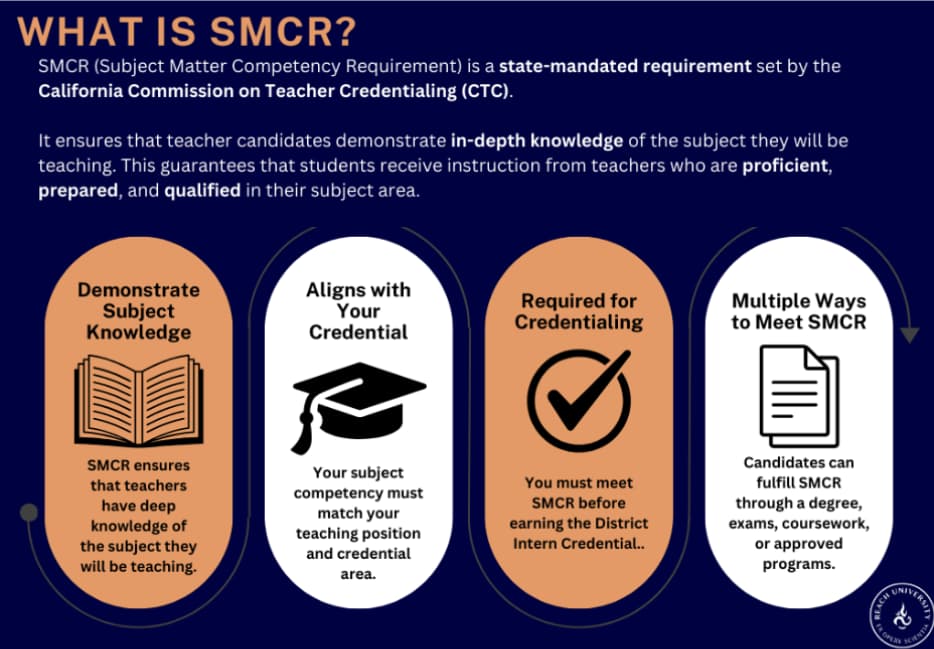
Beyond GPA and units, TAG requires completing specific courses by specific terms. Per UC Merced's published requirements, students must finish one transferable English composition course and one transferable math course by the end of fall before transfer. These are hard conditions, not suggestions.
A persistent source of confusion for students building their own checklists is the ASSIST articulation database itself: it is not always obvious which courses listed there are required for TAG eligibility and which are simply recommended or major-prep. That ambiguity leads students to build inaccurate plans, enrolling in courses they believe satisfy a requirement when they do not, or skipping courses they believe are optional when they are not. Understanding articulation and transfer requirements clearly, before the next enrollment deadline, is not a nice-to-have; it is the prerequisite to every other decision in the TAG process.
Transfermatic's personalized semester-by-semester transfer plan surfaces exactly that distinction, required versus recommended, so your checklist reflects what the UC Merced admissions office actually mandates, not an interpretation of it. What the individual requirements above collectively reveal is that TAG admission is not a single threshold to clear but a multi-layered gauntlet of simultaneous conditions: a GPA floor, unit counts at two separate checkpoints, specific required courses by specific terms, and an exact major match across two separate application portals. Any one of these, if missed, voids the guarantee entirely, independent of how well a student performed on all the others. A student who finishes summer with 32 UC-transferable units but has not yet completed the required math course is not TAG-eligible.
That gap is exactly the kind of silent disqualifier that a semester-by-semester transfer roadmap, built around your specific campus, major, and unit targets, and regenerated whenever your plan changes, is designed to catch before September arrives.
5. TAG Application Window - The September Deadline That Operates Separately from the UC Application
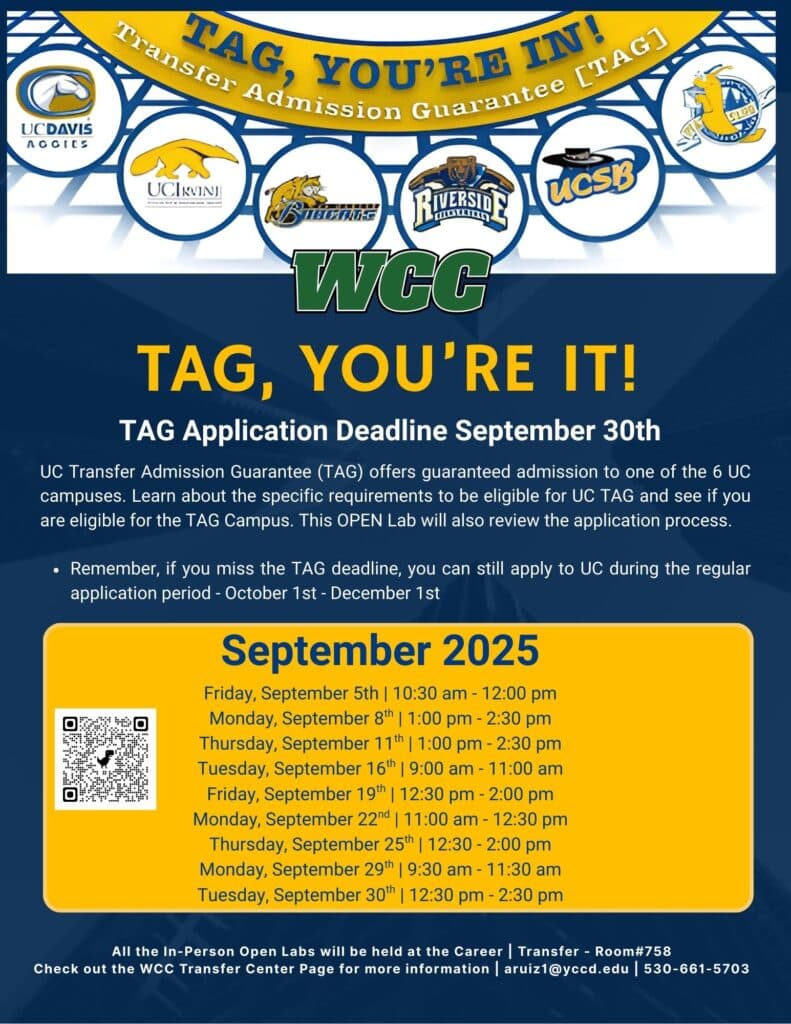
The Transfer Admission Guarantee application must be submitted during a narrow window in September, months before the standard UC transfer application opens in November. Missing this September TAG window means losing the guarantee entirely for that cycle, even if you later submit a strong UC application. Students must also follow through by submitting the full UC application in November; the TAG alone does not complete the admissions process. This two-step timeline catches many first-generation transfer students off guard.
Majors Excluded or Restricted From TAG: the Silent Disqualifier Most Students Miss
Your major is not a placeholder on that application. The field you fill in is a binding commitment, and the gap between what most transfer students assume about that commitment and how UC admissions offices actually enforce it is where a year of careful planning quietly falls apart.

Which Majors Are Actually Excluded From TAG
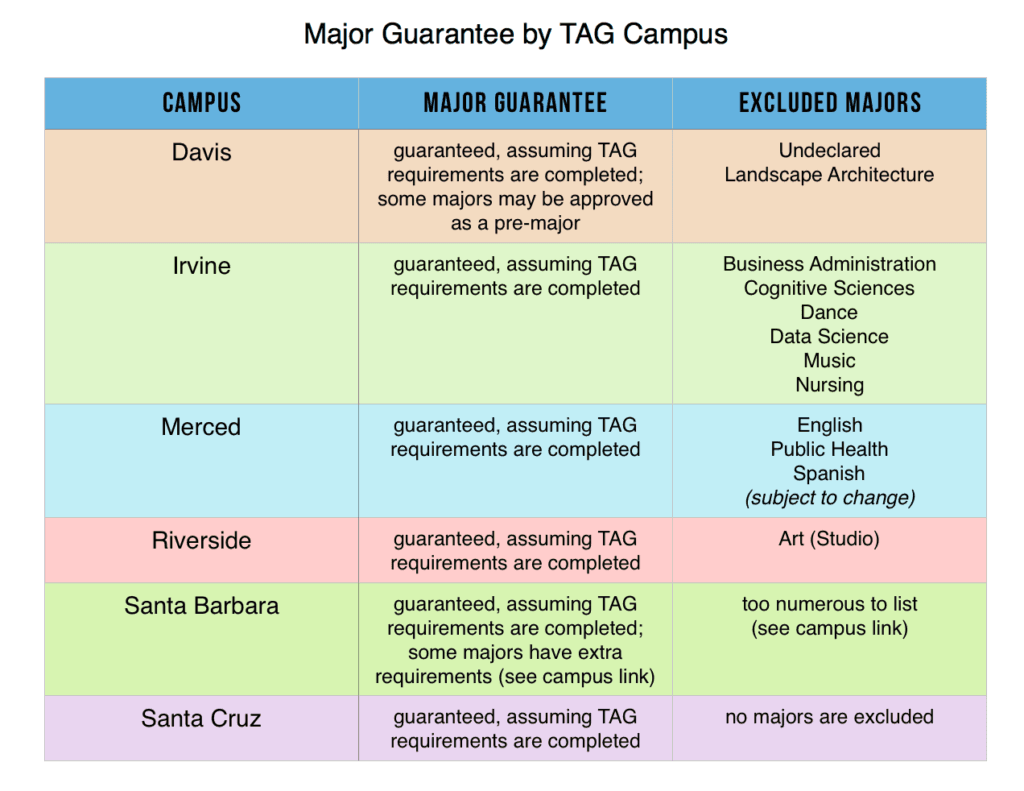
The official lists of TAG-excluded majors exist, but they are scattered across individual campus admissions pages rather than collected in one place, which means most students never see the full picture until they are already deep into a course sequence. UC Irvine Admissions explicitly restricts high-demand programs including computer science and engineering from TAG eligibility entirely. UC Davis offers TAG across a broader range of programs but still excludes or restricts specific majors based on capacity.
A student has to check each campus page separately, and the language used varies enough that "restricted" and "excluded" can look like the same thing when they are not. This is one of the clearest places where starting early makes a measurable difference. From the first planning session, most beneficial when a student is in the early semesters of community college and has a target transfer school or major in mind, Transfermatic surfaces TAG eligibility by major so a student knows before committing to a course sequence whether their intended program even has a TAG path at their target campus.
A student deciding between multiple target universities or majors can use Transfermatic's Articulation Requirement Matching to compare course equivalencies across campuses quickly, which makes the excluded-versus-eligible distinction concrete rather than abstract at exactly the moment the decision still matters.
Impacted vs. Excluded - A Distinction That Matters
An impacted major means demand exceeds available spots, so the campus applies additional screening criteria on top of standard TAG requirements. An excluded major means TAG is simply not available for that program, full stop, regardless of GPA or coursework. A student in an impacted major may still have a path to TAG with extra preparation.
A student in an excluded major has no TAG path at that campus and needs to know that before spending a year building toward one. Transfer students we work with consistently underestimate how early this distinction has to be resolved. By the time a student realizes their major is excluded, often during course registration in their second semester, they have already taken prerequisite coursework optimized for the wrong path.
Transfermatic's Transfer Roadmap Planning addresses this at the start of a student's community college journey and is revisited each semester during course selection, so the personalized semester-by-semester plan a student is following reflects the actual TAG eligibility landscape rather than an assumption that was never verified.
The Major-Match Rule
UC Irvine Admissions states this plainly: any discrepancy, even a minor variation in major name or emphasis, voids the guarantee. A student who applies for TAG as "Computer Science" and then lists "Computer Science and Engineering" on the UC application has broken the agreement on a technicality. There is no appeal window, no correction process.
The guarantee is simply gone. Because Transfermatic's Articulation Requirement Matching works at the level of specific major names as listed by each campus, a student comparing target schools can see the exact program designations used by each UC, not paraphrased versions, before they commit to either application. That specificity is what prevents the single-word mismatch that UC Irvine Admissions confirms will dissolve the guarantee without recourse.
TAG Is a Conditional Agreement, Not an Open Door
UC Davis describes TAG as a written agreement that guarantees admission in a specific major from a California community college, with the emphasis on that specificity: the campus is committed to one declared program, and any deviation from it, before or after submission, dissolves the agreement. The conditions attached to that agreement do not pause between semesters. Transfermatic's plan regeneration and registration deadline reminders keep a student's roadmap current each term, so the coursework being completed continues to satisfy the specific conditions of the TAG agreement as declared, not a generalized version of it. The goal is that when the November filing period opens, there is no scramble to reconcile what was planned with what was actually taken.
How to Apply for TAG - The Step-by-Step Process (and Where Students Go Wrong)
Hitting submit on your TAG application feels like the finish line. It is not even close. By the time you open UC TAP in September, every decision that actually determines your outcome, which campus, which major, which courses, has already been made or missed.
The application is the easy part. The preparation is where students win or lose. For students who are the first in their family to navigate the American transfer system, that preparation gap is especially dangerous.
Without a parent or counselor who has been through this before, it is easy to spend an entire first semester at community college taking the wrong courses, targeting the wrong campus, or simply not knowing that a September deadline is already barreling toward you. Transfermatic is built around exactly that reality: the students and families we work with benefit most when they start planning in the early semesters of community college, not after the first misstep, so that every course selection and every deadline is already mapped before the application window opens.
What UC TAP Is, and Why It's the Only Place Your TAG Application Exists
The UC Transfer Admission Planner (UC TAP) is the official portal where your TAG application lives. There is no alternate submission path. The TAG application window opens September 1 and closes September 30, thirty days, no extensions.
Students who have not already confirmed their course list, GPA, and major before that window opens often spend those thirty days realizing the problem, not fixing it. Transfermatic's registration deadline reminders exist specifically to prevent that scenario. The September 1 open date and September 30 close date are not surprises you should be absorbing in real time; they are calendar anchors that should be locked in from your first semester, reviewed with a student advisor or parent who is tracking the plan alongside you.
The Two-Step Application Sequence Most Students Get Out of Order
Submitting your TAG in September does not complete your application. You must also submit a separate UC application through the UC application portal between October 1 and November 30, confirmed in UC's published dates and deadlines. These are two different systems with two different deadlines.
Missing the second step voids the guarantee entirely, even if your TAG was approved. Think of it as a two-key lock: both have to turn, in order. Parents and guardians reviewing the plan alongside a student are often the second set of eyes that catch this.
Transfermatic is designed for exactly that dynamic, a student working through their personalized semester-by-semester transfer plan, with an optional parent or guardian who can see the same roadmap and flag red flags before they become expensive mistakes. Neither party needs to be an expert in the transfer process. They need a clear, organized plan that surfaces the right steps at the right time.
The Major-Match Rule, Why Both Applications Must Say the Exact Same Thing
The major you list in UC TAP must match exactly the major you list on your UC application months later. A student who writes "Undeclared" in September and then lists "Psychology" in October has a mismatch. Per industry admissions policy, that mismatch can void the TAG agreement regardless of grades or completed coursework.
Two separate systems, months apart, and one clerical difference erases the guarantee. Transfermatic's personalized transfer plan is set at intake and revisited each semester, which means the major a student commits to is documented and visible throughout the planning cycle, not tucked away in a September form that gets forgotten by October. When both the TAG and UC application deadlines are milestones inside the same plan, the alignment between them is far easier to protect.
The One-Campus Rule, Why Choosing Wrong Here Has No Undo Button
You may submit a TAG to one UC campus only. UC admissions policy is explicit on this point. If you choose UC Santa Barbara and later wish you had chosen UC Davis, there is no correction window.
That campus choice has to be right before you apply, which means comparing TAG-participating campuses on major availability, GPA thresholds, and course requirements before September, not after. Transfermatic's Articulation Requirement Matching is most beneficial at exactly this decision point: when a student is weighing multiple target universities and needs to see how their planned coursework maps to each campus's requirements before committing to one. Within minutes of completing the intake and setup, a student can have a transfer roadmap oriented around a specific campus and major, giving them the informed foundation to make a one-campus choice they can stand behind, rather than guessing under deadline pressure.
Confirm TAG Eligibility Before You Build Your Course Plan
Before touching UC TAP, verify that your intended major and community college are actually eligible for the Transfer Admission Guarantee at your target UC campus. Not every major participates; computer science and engineering are frequently excluded or capped. Students who skip this check waste months completing coursework for a TAG pathway that was never available to them, only discovering the error at application time.
Related Reading
- Transfer Articulation
- When Is It Too Late To Transfer Colleges
- Is Community College Free In California
- Community College Transfer Mistakes
- Transferring From Community College To University
- Do Community College Credits Expire
TAG Application Deadlines and Important Dates - The Timeline You Cannot Afford to Miss
The TAG process runs on a timeline that does not bend, and the difference between a guaranteed admission and a standard application often comes down to a single month in September. Missing the TAG application window does not push you to the next step in the process; it removes the guarantee entirely, with no extensions and no way to recover it after September 30. Understanding exactly how the TAG window, the UC application window, and the relationship between them actually work is what this section is built to walk you through.

The TAG Application Window - September 1 to 30, No Exceptions
According to the University of California's official admissions guidance, the TAG application window runs September 1 through September 30, submitted via UC TAP, and it closes with zero exceptions. No extensions, no grace period, no late submissions accepted under any circumstances. The September 30 cutoff is one of the hardest deadlines in the entire UC transfer process.
Miss it by a single day and the TAG portal closes permanently for that cycle. What makes this especially painful is that many students don't discover TAG exists until it is already too late. Students we work with frequently arrive at Transfermatic mid-semester with a target school in mind but no awareness that a guaranteed admission pathway was sitting unused. Others know the deadline but face overwhelming personal circumstances, a family crisis, a stretch of poor mental health, an impossible work schedule, and September 30 arrives before they've had the bandwidth to act.
In either case, the outcome is the same: the guarantee is gone, not deferred.
The UC Application Opens October 1, and It Does Not Save a Missed TAG
The UC application window runs October 1 through November 30, also per UC's official admissions guidance. This is a separate process from TAG, and a common source of confusion. Students sometimes assume that submitting the regular UC application in October somehow compensates for missing the September TAG window. It does not. The two deadlines serve entirely different purposes, and the October application carries no guarantee of admission.
Why September Is Really a Course-Completion Deadline in Disguise
This is the part most students miss. TAG eligibility requires that your required units and prerequisite courses are already completed before the September window opens, not in progress, not planned for next semester. A student who discovers a sequencing error in October cannot fix the coursework and re-enter the TAG window until the following September, meaning a full year lost.
This is precisely why Transfermatic's Transfer Roadmap Planning is built around a personalized semester-by-semester plan that accounts for hidden prerequisites from the start. The tool is most valuable when a student is in the early semesters of community college with a target school or major already in mind, exactly the moment when course sequencing decisions still have time to be corrected. The plan is revisited each semester during course selection, and articulation requirement matching surfaces the specific equivalencies a student needs to satisfy TAG eligibility at their target UC campus.
Registration deadline reminders and plan regeneration mean that if a course gets dropped or a schedule shifts, the roadmap adjusts rather than silently leaving a gap that only surfaces in September. Missing the TAG deadline permanently converts a conditional guarantee into an unprotected general-pool application. The guarantee is gone, not deferred.
Meeting the September deadline is only possible if every course, unit, and GPA milestone was already locked in the semesters before it, which means the real question is not whether you know the deadline, but whether your semester plan was built to hit it.
Why a Semester-by-Semester Plan Is the Only Way to Actually Hit TAG on Time
Most students treat TAG preparation as a checklist problem, finding valid courses and assuming the rest will work itself out. It doesn't, because TAG has timing requirements that a list of eligible classes can't satisfy on its own. What actually determines whether you hit the September window is the order you take those classes in, and whether every unit milestone lands in the right semester before that deadline arrives.

ASSIST.org Is a Lookup Tool, Not a Plan
Confirming a course counts is one step; knowing which semester to take it, whether it lands before the September TAG window, and whether it satisfies a unit milestone at the right moment is an entirely different problem. Most students don't realize the difference until a counselor tells them they're short by one class, and September has already passed. ASSIST.org answers one question: does this course transfer?
It does not tell you when to take it, what to take before it, or whether your current sequence will leave you three units short of the 30-unit checkpoint when September arrives. A student can spend hours cross-referencing course pages and still end up with a list of valid classes in the wrong order. Valid is not the same as sequenced.
Sequenced is what TAG actually requires. This is one of the most common and costly traps students encounter early in community college, and it is exactly the gap a personalized semester-by-semester transfer plan is designed to close. Transfermatic builds that plan from the ground up.
Starting from a student's community college, target school, and intended major, it maps the fastest viable path forward with no wasted classes, verifying the correct articulation matches and laying out every semester in the right order. Students who engage with it in their early semesters, when there is still room to sequence correctly, gain the clearest advantage. The plan can be revisited each semester during course selection, and if circumstances change, it can be regenerated to reflect the new reality.
The Three Simultaneous Clocks TAG Requires You to Hit at Once
TAG doesn't ask you to hit one target. It asks you to hit three at the same time: 30 transferable units by a specific point, 60 units completed before the following spring, and the September application window. Miss any one clock and the guarantee is gone.
According to CalMatters, a significant majority of California community college students who intend to transfer do not complete the transition, and reporting from EdSource and the California State Auditor's 2023 report on community college transfer both identify inadequate academic planning support, not GPA, as the primary driver of that gap. Students are not failing academically. They are failing administratively, because no one handed them a map that accounted for all three clocks at once.
Transfermatic's articulation requirement matching cross-references a student's community college courses against the specific requirements of their target university and major. For students weighing multiple destinations or majors, it surfaces the comparison quickly, so the three-clock problem can be modeled against real options, not abstract ones. Registration deadline reminders keep the September window visible throughout the planning cycle, not just in the weeks before it closes.
How a Single Out-of-Order Course Voids Your Transfer Admission Guarantee
Every class checks out on ASSIST.org. But the student took a required prerequisite one semester too late, pushing their 60-unit total past the spring deadline.
The guarantee is void. One sequencing error, taken in good faith, cost them a full year. This is not a rare edge case.
It is the structural reason most students who intend to transfer on a two-year timeline but have not mapped their courses semester-by-semester end up taking a third year they never planned for. CalMatters has documented how the transfer pipeline breaks down not at the ambition stage but at the execution stage: students who wanted to transfer and simply ran out of correctly ordered semesters. The practical answer is to build the fastest viable semester-by-semester plan before the first semester begins, then protect it each time course selection opens.
Transfermatic generates that plan automatically within minutes of a student completing setup, so the sequencing work is done at the start, when it can still prevent the error, not after a counselor flags it too late to fix. That is a meaningful difference from ASSIST.org lookups and periodic advising appointments that may never surface the sequencing conflict until the window is already closed.
Next steps
If your carefully built transfer plan is at risk of being quietly voided by a course taken in the wrong order or a unit count that falls one class short of the September checkpoint, the path forward starts with treating course sequencing, not GPA, as the real governing variable in TAG eligibility. Start with our best transfer planner for transfer students.
The multi-layered gauntlet of simultaneous conditions, including GPA floors, unit checkpoints at two separate deadlines, and required courses completed by specific terms, means that any single gap independently voids the guarantee regardless of everything else you got right. The two-portal structure, where the major listed in UC TAP must match exactly the major listed months later in the UC application, adds a second category of failure that has nothing to do with grades at all. Together, these two realities point to one conclusion: a semester-by-semester plan built before you register, not after September arrives, is the only structure that keeps every condition in view at the same time.
Start with Transfermatic. Set up your intake, and within minutes you have a personalized roadmap calibrated to your target campus and major, with articulation matches, unit milestones, and deadline reminders built in so no single out-of-order course costs you a year you never planned to spend.
Frequently Asked Questions
Does TAG work for UC Berkeley, UCLA, or UC San Diego?
No. UC Berkeley, UCLA, and UC San Diego do not participate in TAG and never have. Students targeting those campuses must compete through regular admission, which offers no guarantee.
Can I submit a TAG application to more than one UC campus just to be safe?
No, you can only submit a TAG application to one UC campus. That single-campus rule turns the selection decision into a high-stakes commitment, not a casual preference.
What actually happens if I miss just one requirement on the TAG checklist?
Missing any single condition voids the guarantee entirely, regardless of how well you performed on every other requirement. A student with a strong GPA who simply hasn't completed the required math course by the stated deadline is not TAG-eligible.
Is my intended major guaranteed to have a TAG path at my target campus?
Not necessarily. High-demand programs like computer science and engineering are excluded from TAG at some campuses, such as UC Irvine, and other majors may be impacted rather than fully excluded. You need to verify your specific major's eligibility at your target campus before building your course plan around TAG.
Do all my community college units count toward the 30- and 60-unit TAG checkpoints?
No. Only UC-transferable units count. Remedial coursework, basic skills classes, and English-as-a-Second-Language courses below transfer level do not count, so a student who appears to have enough units on their transcript may still fall short of the actual threshold.