Two-thirds of students who plan to transfer never finish. Here is the structural gap the standard process never fixes for anyone transferring from college to university, and exactly how to close it before it costs you a semester.
Not every student who moves from one college to another is walking the same path. The rules, deadlines, and agreements that apply to you depend entirely on which type of transfer student you are, and most students never stop to ask that question before they start planning. Getting it wrong from the first step is exactly how a two-year plan quietly becomes three.
A transfer student is anyone who has earned college credits at one institution and wants to apply those credits toward a bachelor's degree at another. According to the Community College Research Center, that definition covers a wide range of students: those moving from a community college to a four-year university, students switching between four-year schools, adults returning to finish a degree, military veterans, and international students. The category is broader than most people assume, and that breadth is the first source of confusion.

The four main types of transfer students are:
- Community college transfers, students moving from a two-year institution to a four-year university
- Four-year to four-year transfers, students switching between universities
- Nontraditional or returning adult students, adults returning to finish a degree, who represent a substantial share of community college enrollment
- Military and international transfers, students whose credit evaluation processes operate largely outside standard articulation systems
Each group faces different requirements, different application portals, and different credit evaluation processes.
Military veterans face a credit evaluation process that operates almost entirely outside standard articulation systems, which is why a process designed for a traditional community college student will simply not work for them. The community college to four-year transfer pathway has more formal infrastructure behind it than any other type. State articulation agreements, guaranteed admission programs, and standardized general education frameworks exist specifically for this route.
A student moving from a community college to UCLA is a fundamentally different case than one moving between two four-year universities. The tools, deadlines, and agreements are not interchangeable. Every College Transfer Guide worth consulting treats these distinctions as the starting point, and for good reason: knowing which type of transfer student you are is the foundation.
But knowing your type does not explain why so many students who do everything right still end up stuck.
Key takeaways
- Most transfer students don't fail because they skipped steps; they fail because they completed the right steps in the wrong order, and a single missed deadline can add a full year to the timeline.
- 68% of community college students who intend to transfer never do, and following the standard process, counselor meetings, ASSIST lookups, PDF checklists, does not change that number on its own.
- Your transfer type (community college, four-year to four-year, out-of-state) determines which rules, agreements, and deadlines apply to you; most students never ask that question before they start planning.
- Articulation agreements are formal contracts with conditions, not suggestions, and the credits they protect only transfer if you read the fine print before you enroll in the course.
- Financial aid for transfer students runs on a separate set of rules from what you used as a freshman; assuming your funding follows you automatically is one of the most expensive mistakes in the process.
- TAG applications, FAFSA at the new institution, and major-prep prerequisites all cluster in specific semesters; missing any one of them by a few weeks can push your transfer date back by a full year.
- Transfermatic closes the execution gap by generating a personalized, semester-by-semester transfer roadmap built around your major, your target school, and your actual timeline, so nothing slips and no class is wasted.
Why the Standard College Transfer Process Leaves Most Students Behind
According to the National Student Clearinghouse Research Center, only about 1 in 3 students who intend to transfer actually complete a transfer within six years, meaning roughly two-thirds never make it across the finish line. The gap between intention and outcome is not explained by laziness. It is explained by a structural flaw: students are handed tools that confirm individual decisions but never build a complete plan.
Articulation Tools Answer the Right Question, Just Not the One That Controls Your Timeline
1 in 3 transfer intenders actually complete it
Articulation tools like ASSIST and Transferology do exactly what they promise: they confirm whether a specific course is recognized as equivalent at a target school. That is genuinely useful information. What they cannot tell you is whether you also needed a specific lab science in the same semester to stay on a two-year track for your biology major.
Articulation tools verify individual courses. They do not build your plan, and the distinction matters because the question that controls your timeline is not "does this course transfer?", it is "which courses should I take, in what order, for my major and my target school, starting this semester?"
That distinction becomes especially costly when a student is deciding between multiple target universities or majors at the same time. Comparing course equivalencies across schools manually, cross-referencing each institution's articulation agreements while also weighing major preparation requirements, is where plans quietly break down. Transfermatic's Articulation Requirement Matching is built specifically for that moment: when a student needs to compare equivalencies across schools quickly and accurately, so that a single wrong assumption does not lock them into a semester of off-path coursework.
No lookup tool answers the sequencing question alone, but pairing articulation clarity with a personalized, semester-by-semester Transfer Roadmap means a student can see not just whether a course transfers, but whether taking it now keeps them on track for the major and school they are targeting.
Counselor Scarcity Hits First-Generation Students Hardest
The national average counselor-to-student ratio at community colleges is widely documented as extremely high, according to industry research. For a first-generation transfer student, that ratio carries a compounding cost. Continuing-generation students can call a parent who navigated this process. First-generation students cannot.
The problem runs deeper than access to counselors, though. Transfer students navigating 4-year campuses often describe feeling unwelcome seeking help, afraid of being judged or dismissed by staff who are not oriented toward transfer pathways.
That lack of transfer-specific, non-judgmental support is a real structural gap, not a personal failing. Discovering a mistake, such as taking a course that transfers as an elective but not as a major requirement, often happens too late to correct without losing a full semester. A personalized transfer roadmap, generated within minutes of completing an intake and revisited each semester during course selection, removes the dependency on a counselor being available at precisely the right moment.
It is most effective precisely when a student is in the early semesters of community college and has a target school or major in mind: the window when a single semester of off-path courses is still entirely avoidable.
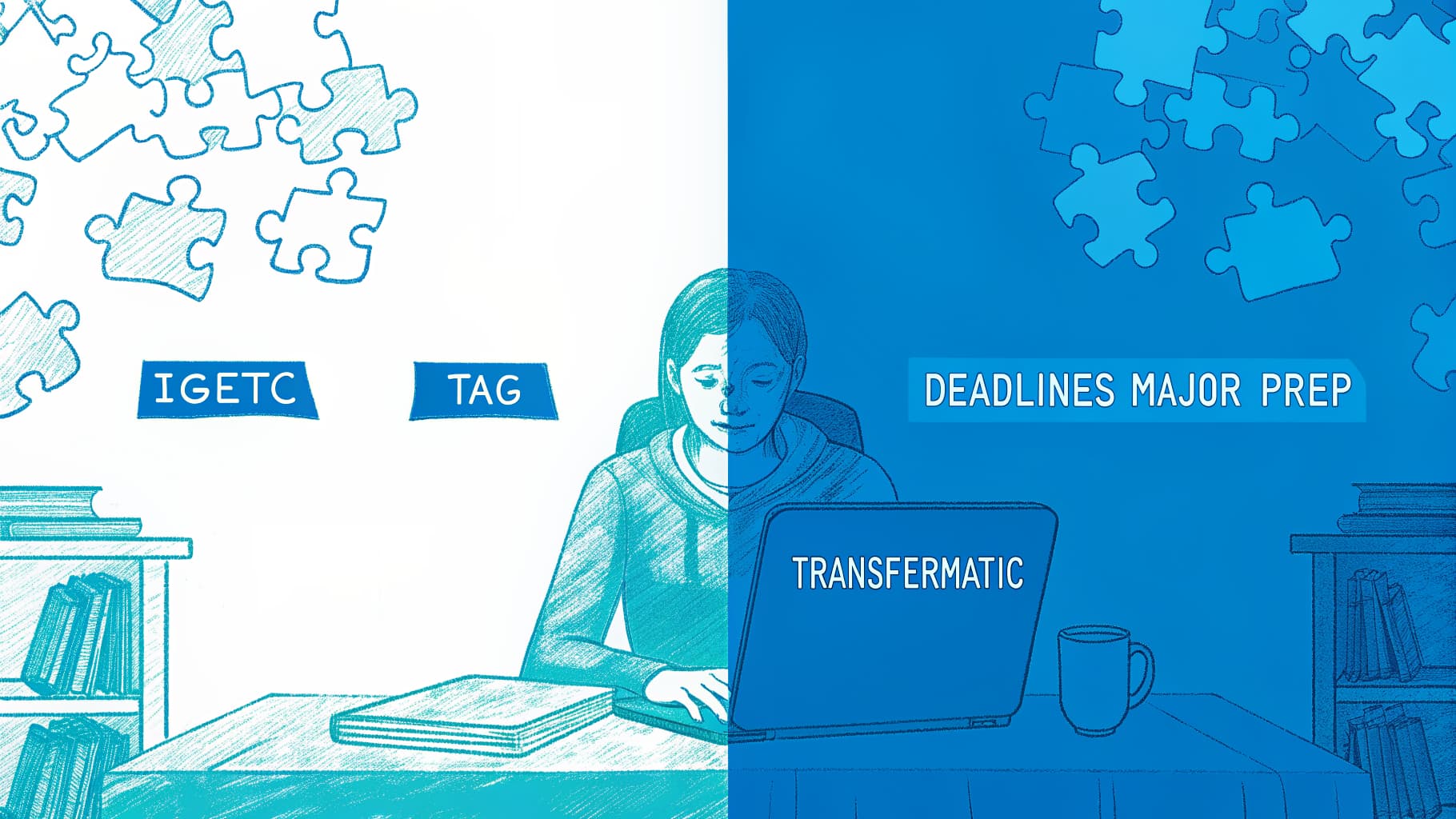
The Disconnected-Steps Trap - Cal-GETC, TAG, Major Prep, and Deadlines
Cal-GETC requirements, TAG eligibility windows, major preparation courses, and application deadlines all operate on different timelines with different rules. None of them automatically connect to each other. The transfer planning mistakes that cost students a year almost always happen at the seams between these systems, not inside any single one of them.
Students also make transfer decisions impulsively, committing to a target school without comparing costs, researching campus culture, or stress-testing whether the academic plan actually holds. Top-ranked students at lower-tier schools sometimes receive acceptance letters from dream institutions only to face a financial reality that paralyzes the very decision they worked years to reach. The process as it stands does not enforce or encourage that due diligence before a student is already committed.
A Transfer Roadmap that surfaces registration deadline reminders, integrates a centralized scholarship finder, and supports plan regeneration when a major or target school changes gives students the infrastructure to make that comparison before it is too late, not after.
Why Starting Your Transfer Plan Early Closes the Gap
The evidence from the National Student Clearinghouse Research Center is consistent: transfer completion rates are low not because students lack ambition, but because the tools available to them were never designed to work together. Articulation Requirement Matching is most beneficial when a student is at risk of taking off-path courses or is considering changing their major or target school mid-transfer, exactly the inflection points where the standard process offers the least guidance. Starting a semester-by-semester plan at the beginning of a student's community college journey, and revisiting it each semester during course selection, is the structural fix the standard process was never designed to provide.
Step-by-Step College Transfer Process - What to Do and When
The sequence of the transfer process matters as much as the steps themselves. Completing each task in the wrong order compounds into real delays, and the Community College Research Center has documented this pattern consistently: students who fail to map transfer requirements from the start of community college enrollment are at high risk of accumulating credits that never count toward their intended degree. The checklist is not the problem. The missing causal chain is.
| ✓ Pros | ✗ Cons |
|---|---|
| Official institution-to-institution articulation system for California pathways | Confirms portability, not whether credit satisfies a specific major requirement |
| Covers hundreds of schools nationwide for fast credit portability checks | A green checkmark confirms portability; it does not confirm placement |
| Agreements negotiated directly between specific institutions, more precise | Course may land in the wrong requirement bucket once registrar processes transcript |
| Fast way to check credit portability across state lines | Neither tool closes the gap on its own |
Before you research schools or pull up any articulation database, name your intended major. Credit policies, course sequencing, and GPA benchmarks all change depending on what you plan to study. A student targeting nursing at a public university needs a completely different course map than one targeting business. Locking in your major first is not a commitment you cannot change; it is the anchor that makes every subsequent step point in the right direction.
1. Clarify Your 'Why' Before You Apply Anywhere
Before researching schools or gathering documents, transfer students must articulate a clear, honest reason for leaving their current institution. Admissions committees scrutinize motivation heavily in the college transfer guide process. Students who can name specific academic programs, research opportunities, or campus resources they lack, rather than vague dissatisfaction, build far stronger applications. The tradeoff: this self-reflection takes real time and may reveal that transferring isn't the right move at all.
2. Step 2: Research Credit Transfer Policies at Every Target School
Credit transferability varies wildly between institutions and can cost students an entire semester or year of progress if ignored. As part of any serious college transfer guide, students should contact registrars directly, review articulation agreements, and confirm which courses count toward their intended major, not just general electives. Transfer students targeting UCs, for example, face strict junior-standing credit requirements. The real limitation: policies change annually and verbal assurances rarely hold up at enrollment.
3. Step 3: Build a Balanced School List with Realistic GPA Benchmarks
Transfer GPA expectations differ dramatically from freshman admissions cutoffs, and many students misjudge their competitiveness by relying on freshman data. A sound college transfer guide directs students to Common Data Sets, school-specific transfer pages, and direct calls to admissions offices to find realistic GPA ranges. T20 schools typically expect 3.5–3.7+, while strong regional universities may accept 3.0–3.3. The tradeoff: self-reported data from forums skews high, making schools appear more selective than they actually are.
4. Step 4: Request Official Transcripts Early Through a Verified Service
Transcript processing is one of the most common bottlenecks in the transfer application timeline, and late submissions can disqualify an otherwise strong applicant. Students should request official transcripts through verified clearinghouse services at least four to six weeks before deadlines, accounting for processing delays at both the sending and receiving institutions. This step is non-negotiable in any college transfer guide. The key limitation: some schools only accept transcripts sent directly from the originating institution, bypassing third-party services entirely.
5. Step 5: Map Out a Semester-by-Semester Transfer Timeline
Timing is everything in the transfer process, and most students underestimate how far in advance planning must begin. A practical college transfer guide maps application deadlines, financial aid priority dates, housing application windows, and prerequisite completion back to a semester-by-semester calendar starting 12–18 months before the intended transfer date. Transfer students targeting four-year universities for junior-year entry face especially rigid timelines. The tradeoff: spring transfer admission cycles are far more limited than fall, restricting options for students on accelerated schedules.
6. Step 6: Craft a Transfer Essay That Explains Growth, Not Just Grievance
The transfer personal statement is the single highest-leverage document in the application, yet most students write it as a complaint about their current school. Effective college transfer guide advice consistently shows that successful essays focus on intellectual growth, specific academic goals, and a clear connection between the target school's offerings and the student's trajectory. Admissions readers at selective schools like Johns Hopkins want evidence of maturity and direction. The limitation: students with legitimate grievances must reframe them constructively without appearing dishonest or evasive.
7. Step 7: Secure Financial Aid and Scholarships Specific to Transfer Students
Financial aid for transfer students operates on entirely different timelines and award structures than freshman aid, and many students miss priority deadlines by assuming the processes are identical. A complete college transfer guide must address FAFSA submission timing, transfer-specific scholarship databases, and institutional aid policies that may reduce awards for students entering with significant credits. Some schools offer merit scholarships exclusively to incoming freshmen, leaving transfers with fewer grant options. The critical tradeoff: waiting for acceptance letters before filing aid paperwork almost always results in reduced award packages.
Credit Transferability and Course Equivalency - How to Check If Your Courses Actually Count
ASSIST and Transferology are genuinely useful tools. ASSIST is the official, institution-to-institution articulation system for California's community college-to-UC and CSU pathways, and Transferology covers hundreds of schools nationwide, giving students a fast way to check credit portability across state lines. What they answer well is one specific question: can this credit move from your college to the target school? What they do not answer, and what actually controls your graduation timeline, is whether that credit satisfies the specific requirement your major demands. A green checkmark confirms portability; it does not confirm placement.
Transfers and Satisfies a Major Requirement Are Not the Same Thing
Credit portability and requirement satisfaction are two completely different outcomes, and confusing them is the single most expensive mistake a transfer student can make. Credits can arrive at a four-year school, appear on your transcript as "accepted," and still count for nothing more than a free elective. A student who completes Calculus I at their community college might see it listed as transferable to a UC engineering program, only to learn at orientation that it mapped to a lower-division elective rather than the required course their major needed.
The semester lost to that distinction is not recoverable. This is one of the most consistent and painful surprises we see transfer students face: arriving at a four-year university with a full load of accepted credits, only to discover after the transfer evaluation that significant required coursework still remains. "Accepted" and "counts toward your degree" are not the same sentence.
Parents who helped fund those community college semesters, counting on each course to move the needle toward graduation, absorb the financial hit of that distinction just as hard as students absorb the time hit. The cost is not abstract: it is an additional semester, or year, of tuition, housing, and lost income.
How to Use Transferology to Check Credit Portability Nationwide
To check whether a course transfers at all, start with Transferology. It is a nationwide network covering hundreds of institutions, and it lets you search how a specific course from your college has been accepted at other schools. Enter your course, select a target institution, and the tool returns any documented equivalency on file.
The limitation is real, though: Transferology confirms portability, not placement. A course showing as equivalent at your target school may still land in the wrong requirement bucket once the registrar processes your transcript. Where Transferology ends is exactly where the planning risk begins, particularly for students who are considering changing their major or target school mid-transfer.
Swapping a target institution after a year of coursework without first comparing articulation agreements across both options is one of the fastest ways to strand credits as electives. Transfermatic's Articulation Requirement Matching is most beneficial precisely at that decision point: when a student is weighing multiple target universities or majors and needs to compare course equivalencies quickly, before locking in a direction that will be expensive to reverse.
How to Use ASSIST.org for California Transfers
ASSIST.org is the official articulation system to consult. Search by your community college, your target UC or CSU, and your intended major to see which courses have been articulated. ASSIST is more precise than a general equivalency lookup because the agreements are negotiated directly between specific institutions, your community college and your target UC or CSU, rather than drawn from a broader national database that may not reflect your school's current bilateral agreement.
Still, a course appearing as articulated on ASSIST tells you it transfers with a recognized equivalency; it does not guarantee that equivalency satisfies the exact requirement your department requires for major progress. As NPR's reporting on community college pathways makes clear, the promise of an affordable bachelor's degree through a community college start depends entirely on whether the credits earned actually advance the student toward that degree, not merely whether they appear on a receiving institution's accepted list. ASSIST gets you closer to that answer than Transferology for California pathways, but neither tool closes the gap on its own.
The Three-Column Check for Transfer Students
The gap between "this course transfers" and "this course advances my degree" is where transfer students lose semesters, and where families lose thousands of dollars on coursework that ends up contributing nothing to a graduation requirement. The core skill every transfer student needs is the ability to know exactly which classes actually count toward their specific school and major, and to avoid taking unnecessary or non-transferable courses before it is too late to change course. The most reliable way to close this gap is to verify three things for every course, not one.
First, confirm the course transfers using Transferology or ASSIST. Second, confirm it satisfies a specific requirement in your major, not just a general elective bucket, by checking your target program's degree audit or contacting the department directly. Third, confirm the course is offered at your community college in the semester you need it, because a course that transfers and counts for the right requirement is no protection at all if you cannot get a seat on time.
Transfermatic's Transfer Roadmap Planning is built around this three-column logic. It is most beneficial when a student is in the early semesters of community college and has a target transfer school or major in mind, exactly the window when off-path choices are still preventable. A personalized semester-by-semester plan, revisited each semester during course selection, keeps every enrolled course connected to a specific requirement rather than floating as a potential elective.
Plan regeneration means that if a student's target school or major shifts mid-transfer, the scenario most likely to strand credits, the plan updates to reflect the new articulation reality rather than the old one. Wasted Semester Prevention is the outcome; a clear, requirement-mapped schedule built before registration opens is the mechanism.
Related Reading
- Transferring From Community College To University
- Community College Transfer Mistakes
- Transfer Articulation
- Is Community College Free In California
- When Is It Too Late To Transfer Colleges
- Do Community College Credits Expire
What Are Articulation Agreements and How Do They Protect Your Credits?
Articulation agreements are the closest thing transfer students have to a binding promise. They are formal contracts between a community college and a four-year university that guarantee specific courses will satisfy specific requirements at the receiving school. But that promise has conditions, and most transfer students never read them.

Articulation Agreements Are Formal Contracts, Not Suggestions
"I get confused and frustrated when courses listed on an articulation agreement (STARS/TCR report) still fail to transfer or aren't applied correctly after I submit my transcript."
An articulation agreement is a legal policy document, not a general assurance that your credits will be fine. According to a 2017 report covered by Community College Daily (citing a GAO August 2017 study), transfer students lose a substantial portion of credits when moving institutions, and poor coordination between colleges is a primary cause. The agreement protects you only when you follow its exact terms: the right course, the right version, the right sequence.
One of the most frustrating experiences transfer students face is completing courses that appear on an articulation agreement, a STARS or TCR report, for instance, only to find those credits fail to transfer or are not applied correctly after transcript submission. This happens because a course that appears transferable in a general equivalency lookup is not the same as a course that satisfies a major requirement under a formal articulation pathway. That distinction costs students full semesters.
Students without frequent access to personalized counselor appointments are especially exposed to this risk, because there is no one catching the mismatch before registration. Transfermatic's Articulation Requirement Matching is designed for exactly this gap: it is most useful when a student is deciding between multiple target universities or majors and needs to compare course equivalencies quickly, surfacing the specific requirements each pathway demands before you ever register.
Finishing Your AA or AS Before You Transfer
Completing your associate degree before you transfer is not just a milestone. In many states, finishing your AA or AS triggers additional protections built into the articulation agreement, including guaranteed acceptance of your general education requirements without course-by-course review. The trade-off is real: finishing the degree takes longer, and some students prefer to transfer earlier to avoid the extra semester.
That pressure is compounded for students who only attend a California community college for a single year. One year leaves almost no margin to complete every course an articulation agreement names before the application window opens. That is a legitimate constraint, not a character flaw, and it is one of the reasons Transfermatic generates a personalized semester-by-semester transfer plan that is most useful at the very start of a student's community college journey, then revisited each semester during course selection.
Seeing the full sequence mapped out in the early semesters, within minutes of completing setup, lets students make a deliberate choice about which protections they can realistically complete and which trade-offs they are accepting when they apply early.
TAG, The Strongest Form of Articulation Most Students Never Use
The Transfer Admission Guarantee program, available through the UC system, is the most powerful formal pathway available to California transfer students. A student who meets the TAG requirements for a specific UC campus receives a written guarantee of admission before the general application cycle even opens. TAG applicants historically see higher acceptance rates than general transfer applicants at the same campuses.
The catch: TAG requires a separate application, a minimum GPA that varies by campus and major, and completion of specific courses the agreement names. Miss one requirement and the guarantee disappears entirely. This is precisely the kind of multi-variable comparison, GPA thresholds, required courses, campus-by-campus differences, that is difficult to track manually and nearly impossible to compare across multiple target schools at once.
Transfermatic's Articulation Requirement Matching surfaces these differences side by side, which matters most when a student is weighing two or three UC campuses before committing to a single TAG application. Students who lack regular access to a counselor, or who are weighing the cost of private advising services, get the same structured comparison through the platform.
The Fine Print That Voids Your Protection
This is where the real risk lives. Even motivated students who find and read their articulation agreement can misread which course version the contract actually requires. A single substituted course, say MATH 1B when the agreement specifies MATH 1A, can invalidate the pathway protection entirely.
The registrar at your target school evaluates your transcript against the written agreement, not against your assumption of equivalency or anything a general articulation database returned. National Student Clearinghouse research and reporting on the GAO findings both confirm that credit loss remains a systemic problem rooted in exactly this kind of coordination failure between institutions. Before you register for any course you intend to rely on under an articulation pathway, pull the actual agreement document, find the exact course number it names, and confirm with both your home campus counselor and the receiving school's transfer office that the version you are taking matches.
Transfermatic's Transfer Roadmap Planning and automatic schedule creation are built to reduce the manual burden of that verification step, and registration deadline reminders mean the confirmation window does not quietly close before you act. For students building a financial picture alongside their academic one, the platform's centralized scholarship finder consolidates funding options that are otherwise scattered across individual college and program pages, removing one more research task from an already crowded checklist.
Transfer Financial Aid and Scholarships - How to Keep Your Funding When You Move
Financial aid for transfer students operates on a completely different set of rules than most students expect, and the gap between assumption and reality can cost a full semester's tuition. The number of students transferring grew 4.4% between fall 2023 and fall 2024, according to the National Student Clearinghouse Research Center, meaning more students than ever are walking into this funding blind spot at the same time.

FAFSA Does Not Follow You - What You Must Do Before Your First Day
Transfer financial aid eligibility resets at every new institution. A student who received a Pell Grant at community college must refile the FAFSA listing their new university before federal aid flows to that school. Missing this step, or filing late, can leave you funding an entire semester out of pocket while the financial aid office catches up. Financial aid processing delays of two months or longer are not unusual, creating serious financial uncertainty at exactly the moment you are trying to confirm enrollment. For the 2025–2026 award year, most schools process aid on a rolling basis after your FAFSA is received, so earlier is always safer.
How Your Transfer GPA Affects Both Admission and Aid
The same GPA that determines whether you get in often determines how much funding you receive. Transfer admission thresholds vary widely depending on the institution, ranging from open-access to highly selective, with competitive universities often setting significantly higher GPA bars than their overall acceptance rates suggest. A GPA shortfall does not just threaten your spot; it can collapse the entire financial package you were counting on.
What catches many students off guard is just how steep the dollar difference can be between institutions. The cost jump from a community college semester to a four-year university semester is not hypothetical; it is a financial leap that families routinely underestimate until the first bill arrives. Understanding your aid picture at each target school before you commit is the only way to make a genuinely informed decision.
Transfermatic's Articulation Requirement Matching is most useful precisely at this stage: when you are deciding between multiple target universities or majors and need to compare course equivalencies quickly, having a side-by-side view of how your credits, and therefore your standing, translate at each school can reveal which offer actually costs less to complete.
Transfer-Specific Scholarships Most Students Never Search For
Institutions across the country offer scholarships built exclusively for transfer students, separate from the general aid pool that freshmen compete for. Search your target school's financial aid page specifically for the word "transfer" alongside "scholarship" before assuming the only money available is need-based federal aid. A complicating layer that few students think to ask about: whether a named transfer scholarship automatically carries additional financial benefits, such as an out-of-state tuition waiver, or whether those benefits require a separate application entirely.
Institutions rarely communicate these distinctions clearly, and assuming one award covers everything can leave a significant gap in your budget. Transfermatic's centralized scholarship finder is built to surface transfer-specific awards and flag the conditions attached to them, so you are not piecing together policy language from five different financial aid pages on your own.
The Merit Scholarship Trap - Freshman Awards Are Often Off-Limits
This is the funding mistake that arrives too late to fix. Merit scholarships designated for incoming freshmen are frequently closed to transfer applicants entirely, and most students discover this restriction only after committing to a school. Transfer students have significantly fewer merit scholarship opportunities than freshmen, a well-documented structural disadvantage that makes early, targeted research non-negotiable.
Ask each target school's financial aid office specifically whether any merit awards are open to transfer applicants, what the GPA and credit thresholds are, and whether a separate application is required, because these awards rarely appear in general scholarship search engines and the deadlines often fall before you have committed to the school. The earlier you start mapping this landscape, the more options remain open to you. Transfermatic's Transfer Roadmap Planning is most effective when a student is in the early semesters of community college and already has a target school or major in mind, precisely because scholarship deadlines, GPA benchmarks, and prerequisite sequences all interact.
A personalized semester-by-semester transfer plan built at the start of your community college journey, and revisited each semester during course selection, gives you the confidence to stop second-guessing every registration decision and know that each class you take is moving you toward the strongest possible application, and the strongest possible aid package.
What Documents and Materials You Need for a Transfer Application
Transfer applications fall apart less often on grades than on missing or mistimed paperwork. Each piece of your file, from official transcripts to supplemental program requirements, has its own lead time and its own rules about what substitutes are acceptable, which means a disorganized approach can sink a competitive application before a reader ever sees your GPA. Knowing exactly what you need, and when to start on it, is where the process either comes together or quietly unravels.
Transfer applications require a distinct set of documents, and the gap between what students expect to submit and what programs actually require is where strong candidates get screened out.
1. Official College Transcripts - Your Most Critical Document
Official transcripts sent directly from your current institution are non-negotiable for nearly every transfer application. Most schools, including CUNY, will not review unofficial copies under any circumstances. The key tradeoff: if you're mid-semester, you may need to submit current official transcripts now and final ones after grades post, which requires careful timing and coordination with your registrar.
2. Transfer Personal Statement - A Purpose-Driven Narrative, Not a Recycled Essay
The transfer personal statement is not a recycled freshman essay. Admissions readers flag essays that look backward without explaining the move forward. A strong transfer personal statement answers two questions directly: why you are leaving your current institution, and how the target program connects to a specific academic or professional goal. Generic essays that could apply to any school are the most common reason otherwise competitive files feel flat.
3. Letters of Recommendation - College Professors Over High School Teachers
Letters of recommendation for transfer applicants should come from college professors, not high school teachers. Request letters at least six weeks before the deadline, because professors who receive requests two weeks out frequently cannot write a thoughtful letter in time. Transfermatic's RateMyProfessor integration helps students identify strong instructors at the start of each semester, so that by the time recommendation season arrives, you have already built relationships with professors worth asking.
4. Midterm or In-Progress Grade Report - Proof of Current Academic Standing
Many selective schools require a midterm report showing your current grades in ongoing coursework, not just your historical transcript. Crucially, this report reflects your overall standing in each class at the time of submission, not just a single exam score, and is typically completed by your professor rather than you. The tradeoff: for classes without formal midterms, you must coordinate with instructors to provide an estimated grade, which can be awkward.
5. Résumé or Activity Record - Documenting Work, Leadership, and Community Involvement
The Common App for Transfer's support information section allows you to upload a résumé and detail work history, community involvement, and family commitments. This document gives admissions officers a fuller picture of who you are beyond GPA. Transfer students often have richer work and life experience than first-year applicants, making this a genuine differentiator. The tradeoff is that poorly formatted or unfocused résumés can undercut an otherwise strong application.
6. FAFSA and Financial Aid Documentation - Securing Funding Before Enrollment
Transfer students must submit a new or updated FAFSA to be considered for federal financial aid at their destination school, and many institutions require this before finalizing enrollment. You'll need your FSA ID, tax records, and Social Security information ready. The critical tradeoff is timing, FAFSA processing takes weeks, and missing a school's priority aid deadline can mean losing institutional grant money even if you're admitted.
The Transfer Planning Timeline - A Semester-by-Semester Map So Nothing Slips
A two-year transfer plan looks simple on paper: take your classes, meet your counselor, apply in the fall of your second year. The part nobody shows you is that TAG applications, FAFSA at the new institution, and major-prep prerequisites all have hard deadlines that cluster in specific semesters, and missing any single one by a few weeks can push your transfer date back by a full year.

Why this striking gap exists
The National Student Clearinghouse Tracking Transfer report found that fewer than half of transfer-intending students at two-year colleges actually transfer within five years. That is not a motivation problem. It is a sequencing problem.
The transfer pipeline has four distinct stages:
- Enrollment
- Academic preparation
- Application
- Matriculation
A delay at any one stage breaks the entire chain. Students who discover a missed prerequisite or a closed TAG window in semester three are not careless; they simply had no map that showed them what had to happen in semester one.
International students face an even steeper barrier: acceptance rates for international transfer applicants at elite US universities are extremely low, which makes every semester of sequencing feel higher-stakes than it already is. Getting the plan exactly right, no wasted classes, no missed windows, is not optional when your margin for error is that thin. It is the only viable strategy.
Semester 1 (0 to 15 Credits): Lock In Your Major and Target School First
Before you register for a single course, confirm your major and target school. Every course decision downstream depends on this. If you register for general electives while still "deciding," you risk filling your schedule with credits that satisfy nothing specific.
This is especially true for students who do not have frequent, personalized access to a counselor. Without someone reviewing your specific major requirements against your specific target school from day one, it is easy to spend an entire semester moving sideways. Transfermatic's Transfer Roadmap Planning is built for exactly this opening moment. Within minutes of completing the intake setup, it produces a personalized, semester-by-semester transfer plan from your community college to your target school for your declared major, with no wasted classes.
It is most beneficial when used at the very start of your community college journey, the same moment your course decisions still have maximum flexibility, and it surfaces which major-prep courses your target school requires, including any that carry prerequisites of their own. Those hidden prerequisites are the most common reason students end up needing a fifth semester. For students weighing more than one target school or major, Transfermatic's Articulation Requirement Matching lets you compare course equivalencies across institutions quickly, so you are not manually cross-referencing multiple ASSIST pages while your registration window closes.
Semester 2 (16 to 30 Credits): TAG, Credit Audit, and Hidden Prerequisites
TAG applications for UC campuses open and close in September (September 1-30) of your second year at community college, which means the groundwork has to be laid in semester two, not semester three. Run your first formal credit audit now: count what you have completed, what is in progress, and what is still missing. This is also when you should meet with a counselor at your target institution, not just your home campus.
The two conversations often produce different information, and the gap between them is where transfer plans quietly fall apart. Your home campus counselor knows what courses you can take; the receiving school's transfer office knows which of those courses will actually count toward your major. Both conversations are necessary, and neither one substitutes for the other. Students who do not have regular access to personalized counselor appointments, or who cannot afford private advising, are most exposed to this gap.
Transfermatic is designed as a private-counselor alternative for exactly that situation: it tells you which classes to take, in what order, so you actually get into your target school on time, without spending money on classes that will not count or losing a semester to a sequencing mistake. The plan is revisited each semester during course selection, and registration deadline reminders keep TAG windows, prerequisite deadlines, and application dates visible before they become emergencies. If your situation changes, a major shift, a new target school, Plan Regeneration rebuilds your roadmap without requiring you to start from scratch or wait for a counselor appointment slot to open up.
The National Student Clearinghouse data is consistent: the students who do not transfer on time are not failing because they lack drive. They are failing because they had no system showing them the right sequence at the right time. A personalized, automatically updated semester-by-semester plan, anchored to your actual major, your actual target school, and your actual credit count, is the structural fix that replaces guesswork with a timeline you can execute.
Related Reading
- What Are Credit Hours
- How Much Does Community College Cost
- Transfer Admission Guarantee
- How Do College Credits Work
- How To Transfer Schools
- Best Schools To Transfer To
Next steps
If your credits keep landing as "accepted" but never advancing your degree, the path forward starts with a semester-by-semester roadmap built around your specific major, your specific target school, and the deadlines that actually control your timeline. Start with our best transfer planner for transfer students.
Phantom credits, the ones that transfer but satisfy nothing toward your major, happen because articulation tools confirm portability, not placement. That distinction costs students full semesters with no warning from any official system. At the same time, the transfer process is not a single event but a multi-semester pipeline where one missed prerequisite or closed TAG window in semester two compounds into a full-year delay by semester three. Knowing both of these things points to one logical next step: stop checking individual courses and start building a connected sequence before registration opens.
Start with Transfermatic. Enter your major, your target school, and your current credit count, and Transfermatic generates a personalized, semester-by-semester course map you can register from, updated each semester so a changed major or new target school never strands your existing credits.
Frequently Asked Questions
What exactly is a transfer student?
A transfer student is anyone who has earned college credits at one institution and wants to apply those credits toward a bachelor's degree at another. The category includes students moving from a community college to a four-year university, students switching between four-year schools, adults returning to finish a degree, military veterans, and international students.
How does the community college to four-year university transfer path work?
The community college to four-year transfer pathway has more formal infrastructure behind it than any other type, including state articulation agreements, guaranteed admission programs, and standardized general education frameworks. However, steps like Cal-GETC requirements, TAG eligibility windows, major preparation courses, and application deadlines all operate on different timelines with different rules, none of them automatically connect to each other, which is where most plans break down.
What are articulation agreements and why do they matter?
Articulation agreements are negotiated directly between specific institutions and document how courses from one school are recognized as equivalent at another. They are useful for confirming whether a credit can move from your college to a target school, but they do not tell you whether that credit satisfies a specific major requirement, a distinction that can cost you an entire semester if you get it wrong.
When should I start planning my transfer, and what should I do first?
Start at the very beginning of your community college enrollment. Students who fail to map transfer requirements from the start are at high risk of accumulating credits that never count toward their intended degree. The first step is to name your intended major before researching schools or checking any articulation database, because credit policies, course sequencing, and GPA benchmarks all change depending on what you plan to study.
I'm a nontraditional or returning adult student, does this process apply to me?
Yes, nontraditional and returning adult students are one of the four main transfer student types and make up a significant share of community college enrollment, with adults over 25 representing a substantial portion of all community college students. The same structural risks apply, particularly the risk of taking off-path courses, and a semester-by-semester plan built around your specific major and target school is especially valuable for reclaiming time efficiently.