Yes, your credits transferred. No, they may not count toward your degree. Those are two different things, and the gap between them is where extra semesters are born.
The common assumption among students planning to transfer is: "If I can confirm that a course 'transfers,' I'm good, I just need to find the right list and follow it." Most students transferring from college to university do exactly what they're supposed to do. They check the articulation list, sit down with a counselor, and pick courses that appear to transfer. They feel confident. Then they arrive at their target university and find out that "transfers" and "counts toward your degree" are two completely different things. That gap, quiet and invisible until it's too late, is where extra semesters are born.
The Community College Research Center's 2024 tracking data found that only 14% of transfer-intending students actually complete a bachelor's degree within six years. That number is not driven by students who gave up or failed academically. It is driven, in large part, by students who followed the process in good faith and still ended up with credits that didn't move them forward.
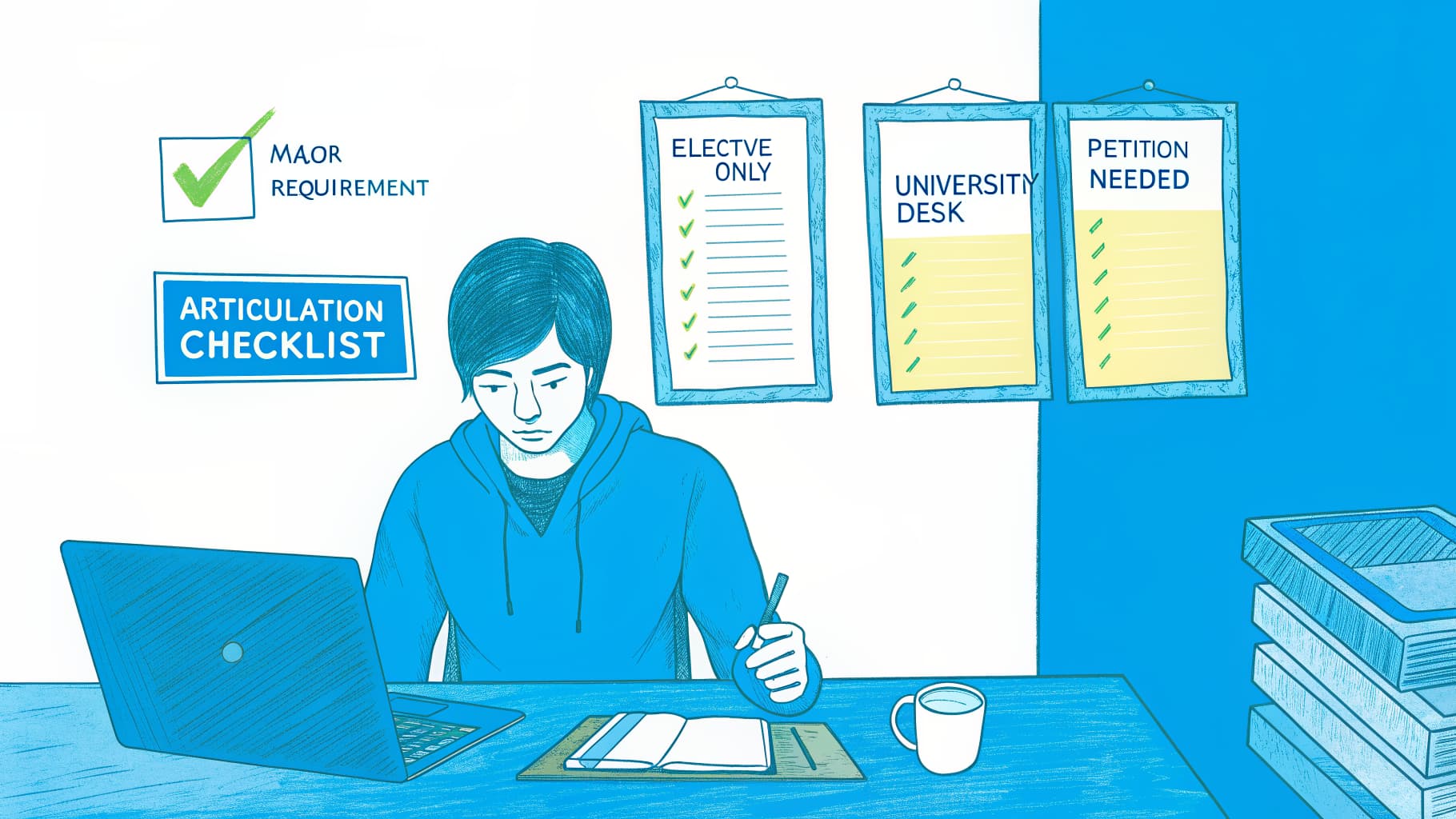
A course gets accepted by the university's registrar, assigned a course number, and posted to the transcript. None of that guarantees it satisfies a single requirement in your declared major. Transferability is a three-variable equation: receiving institution, declared major, and credit type.
Change any one of those variables and the answer changes. A course that satisfies a core requirement for a Business major at one CSU campus may count only as an elective at another, or require a department petition at a third. The same credit, three different outcomes, depending entirely on where you're going and what you're studying.
Transfer effectiveness, as the CCRC research frames it, is a two-institution problem. The sending community college and the receiving four-year university each make independent decisions that do not always align. A course can be listed in a statewide articulation framework and still be rejected at the department level because major requirements are set by faculty, not by the transfer agreement. That structural reality is what makes the yes/no question so dangerous. Tools like Transfermatic exist precisely to collapse all three variables into a single, navigable view:
- Receiving institution
- Declared major
- Credit type
This lets students see how a course performs against actual degree requirements before they register, not after.
14% of transfer-intending students finish a bachelor's
Key takeaways
- A course listed as 'transferable' and a course that counts toward your major are two different things—most students don't find out they're not the same until after they've enrolled.
- Credit evaluation happens in two separate stages: a provisional award at admission, then a final audit after enrollment, and the second stage is where credits quietly disappear.
- Articulation agreements tell you what transferred for other students before you; they don't tell you whether those courses satisfy your specific major's lower-division requirements at your specific target school.
- Missing the three-way alignment between target school, intended major, and application semester can turn a technically transferable course into one that adds a full extra semester to your degree.
- Rejected credits aren't a bureaucratic inconvenience—they're a financial hit that compounds into tuition for repeated classes, delayed graduation, and lost income.
- Checking ASSIST or a counselor's list is a starting point, not a plan; the preparation steps that actually protect your credits are ones most students never knew they were supposed to take.
- Transfermatic builds personalized transfer roadmaps that map your specific courses to your specific major at your specific target university, so you know which credits count before you register, not after you arrive.
The Transfer Credit Evaluation Process - What Actually Happens to Your Transcripts
The common assumption among students planning to transfer is: "If I can confirm that a course 'transfers,' I'm good, I just need to find the right list and follow it." Getting admitted to a four-year university feels like the finish line. It isn't.
The moment your acceptance letter arrives, a second, entirely separate process begins in a different office, run by different staff, using criteria your admission officer never mentioned. According to a 2021 analysis published by Journalist's Resource, transfer students lose an average of 43% of their credits when moving from a community college to a four-year university. That number doesn't reflect academic failure.

It reflects a process most students never knew existed, and one that is far easier to navigate when you understand its structure before you enroll in a single course.
Step One - Transcript Submission and the Registrar's First Filter
43% of credits lost in transfer on average
After admission, the registrar's office requests your official transcripts. This is not a formality. The registrar runs an independent review that has nothing to do with why you were admitted.
They check whether your credits meet the receiving institution's baseline standards before any course-level matching begins. Credits that fail at this stage are removed from consideration entirely, before anyone even looks at what the course covered. One of the most disorienting moments in this process is the first time a student logs into their new portal and notices a "Transfer Credit Evaluation" tab has appeared.
Many students interpret that tab as a positive signal, proof their credits are being counted. It isn't. It means the evaluation is underway, and its outcome is not yet determined.
Understanding what that tab actually signals, and what decisions are still being made behind it, is the difference between students who act in time and students who don't. This is precisely why Transfermatic is most valuable at the very beginning of a student's community college journey, not after admission. When a student has a target transfer school or major in mind, even tentatively, Transfermatic builds a personalized semester-by-semester transfer plan within minutes of completing intake.
That plan is built around articulation requirement matching, so the courses a student registers for are selected against the actual requirements of the receiving institution from day one.
Why Regional Accreditation Is the Non-Negotiable Gate Most Students Never Hear About
Regional accreditation is the first filter the registrar applies, and it eliminates more credits than most students expect. Credits from regionally accredited institutions are generally accepted for review. Credits from nationally accredited schools are routinely rejected outright, regardless of the grade earned or the course content, according to Journalist's Resource's 2021 reporting on transfer barriers. The painful part: many students enroll at nationally accredited institutions without anyone telling them this distinction exists.
The Four Credit Killers Hidden Inside the Articulation Matching Stage
Once accreditation clears, the registrar matches each course against the receiving school's catalog. Four structural problems kill credits at this stage. First, remedial and sub-100-level courses are almost never counted toward degree credit.
Second, grades of D or below are rejected at most universities even if the course itself would otherwise transfer. Third, courses with no direct equivalent at the receiving school often land as unspecified electives, which may not satisfy any requirement. Fourth, courses taken before an articulation agreement was updated may no longer match, even if they matched when you enrolled.
Students deciding between multiple target universities or majors face a compounded version of this problem: the same course can transfer cleanly to one school and land as a dead elective at another. Transfermatic's articulation requirement matching is designed specifically for this comparison, so a student can see how their planned coursework maps against different target schools before committing to a path, not after credits have already been lost. The plan Transfermatic generates is not a one-time document.
It is revisited each semester during course selection, and the plan can be regenerated as a student's target school, major, or circumstances change. Registration deadline reminders are built in, so the practical logistics of executing the plan don't fall through the cracks.
Credit Posting - Transferable vs. Counts Toward Your Major
The registrar's final step is posting credits to your record. A course can be accepted as transfer credit and still be coded as a free elective rather than a major requirement. Those two outcomes look similar on paper and feel very different at graduation.
A student who earned a B in a chemistry course, for example, may find it accepted as transfer credit by the registrar and still discover at registration that it satisfies no requirement in their declared major, because the department, not the registrar, controls what counts toward graduation. There is one more layer most students never learn about until it is too late: the appeal window. At most institutions, students have a limited period, often 30 days, to contest a transfer credit decision.
Missing that window is not a minor inconvenience. Students who discover the appeal process a year after starting can find themselves completing entirely redundant coursework because a decision that could have been reversed was never challenged. A faster, cleaner transfer path to a target university depends not just on planning which courses to take, but on knowing what actions are available, and when, after the evaluation is complete.
That is the kind of articulation and transfer requirement clarity that makes the difference between finishing on time and adding an unnecessary semester.
Transferring Credits to a Specific University - Why the Rules Change by Major and School
The word "transferable" printed next to a course in a college catalog feels like a green light. It isn't. Across the broader landscape of higher education, many transfer students arrive at four-year universities only to discover that a significant portion of their credits do not apply toward their intended degree program, forcing them to retake courses or extend their time to graduation.
The label "transferable" tells you a credit will be accepted somewhere. It says nothing about whether it will count toward the specific major you declared at the specific school you chose. The core synthesis here is this: a course appearing on ASSIST and transferring successfully is not the same as that course counting toward your major, because the evaluation that determines degree progress happens at the receiving department level, not the admissions level, and these two decisions are made independently, at different times, by different people with different criteria.

Students who conflate "my credits transferred" with "my credits count" are unknowingly betting their graduation timeline on a distinction the system never explains to them. This confusion cuts even deeper for students whose credits originate outside traditional community college pipelines. Students who attended schools like Full Sail University often discover, too late, that their credits are not accepted at state universities, a situation that draws uncomfortable comparisons to now-defunct institutions like ITT Tech.
By the time those students attempt to transfer, they have burned time and money on coursework that a receiving department will simply not count. The lesson is brutal and preventable: knowing which classes actually count toward a specific school and major, not just which ones transfer in some abstract sense, is the only planning standard that protects a student's timeline.
Statewide Transfer Pathways vs. School-Specific Articulation Agreements
California's Intersegmental General Education Transfer Curriculum (IGETC) is a good example of a statewide pathway that works exactly as advertised, but only for general education. Complete IGETC, and a UC or CSU campus will typically waive its lower-division general education requirements. That is a real, system-wide promise.
The problem is that IGETC says nothing about your major preparation courses. Those are governed by school-specific articulation agreements, and each campus negotiates its own terms. The Associate Degree for Transfer (ADT) in Business, for instance, guarantees junior standing at a CSU campus.
That is a meaningful protection. But the same ADT provides no equivalent guarantee at a UC, where each campus and each department evaluates major preparation independently. Two students with identical transcripts can have very different outcomes depending solely on which school they chose and which department reviewed their file.
This is precisely where Transfermatic's Articulation Requirement Matching is most valuable: when a student is deciding between multiple target universities or majors and needs to compare course equivalencies quickly, side-by-side, before committing to a semester's worth of coursework that may satisfy requirements at one campus but land as a free elective at another.
The Major-Specific Trap - General Education Credit Is Not Major Preparation Credit
The most common planning mistake is treating all transferable credits as interchangeable. They are not. A course can satisfy a general education science requirement and still count for nothing toward a nursing or engineering major's lower-division prerequisites.
The evaluation that determines degree progress happens at the receiving department level, not the admissions office. Admissions confirms you are accepted. The department decides whether your coursework counts toward graduation.
These two decisions are made independently, at different times, by different people using different criteria:
- A nursing student targeting one CSU campus may find that a biology course satisfies a core prerequisite.
- The same course at a neighboring CSU campus may require a department waiver before it counts at all.
The course did not change. The articulation agreement did. A Calculus I course can fulfill a core engineering prerequisite at one UC campus and land as a free elective at another, depending on the agreement in place and when it was last updated.
What most transfer students discover too late is that a substantial share of their accepted credits still fail to satisfy a single requirement in their declared major, making the gap between "transferred" and "counted" one of the most consequential and least-publicized costs in higher education. The students who escape this trap are the ones who know exactly which classes actually count toward their specific school and major before they register, not after. Transfermatic is built around that standard.
Immediately upon entering school and major preferences, students receive a personalized, semester-by-semester transfer plan that maps their community college coursework to what their target school's department actually requires. That plan is most powerful at the start of a student's community college journey, when every course selection still shapes the final outcome, and it is revisited each semester during course selection so that a changed articulation agreement or a shifted major doesn't quietly derail a timeline that looked fine a year ago. When circumstances change, Transfermatic's plan regeneration rebuilds the fastest viable path forward, with no wasted classes.
A course can satisfy a general education science requirement and still count for nothing toward a nursing or engineering major's lower-division prerequisites.
Preparing for the Transfer Process - How to Protect Your Credits Before You Apply
Checking ASSIST before you register is smart. Stopping there is where the plan starts to break down. The difference between a transfer that finishes in two years and one that quietly stretches to three often comes down to a handful of preparation steps that most transfer students never knew they were supposed to take, and the cost of skipping them shows up only after it is too late to fix. Research into why community college students fail to transfer consistently points to planning gaps that compound semester by semester, gaps that are hardest to catch precisely when a student is considering a mid-transfer change of major or target school.

Use Articulation Tools Before You Register, Not After
Articulation tools show you whether a course can transfer. They do not tell you whether it will satisfy a specific requirement in your specific major at your specific target school. A course can appear as "transferable" and still land as a free elective, satisfying nothing on your major prep list.
Articulation agreements map courses to requirement categories, and students who consult these tools before enrolling are better positioned to avoid completing courses that transfer in name only, a distinction transfer advising research consistently identifies as one of the most common planning oversights. The operative word is "before." Checking after you have already finished the course leaves you with no options.
This is where Transfermatic's Articulation Requirement Matching is most useful: it is designed specifically for moments when a student is deciding between multiple target universities or majors and needs to compare course equivalencies quickly, before the next enrollment deadline, not after. Catching a mismatch before you register is the entire point. Catching it after costs you a semester.
Why Verbal Counselor Guidance Is Not a Safety Net
Counselors work hard and advise in good faith, but they are not employed by your target university's department, and they carry no authority over how that department evaluates your coursework. Transfer advising literature consistently notes that verbal counselor guidance is not binding on the receiving department, and students are better protected when they seek written confirmation directly from the department that will evaluate their coursework. Even written confirmation carries a structural limit: articulation agreements can change between the semester you plan and the semester you enroll. Get the written confirmation anyway, then treat it as a starting point, not a finish line.
For parents trying to support a transfer student, this dynamic is one of the hardest to navigate: understanding the transfer process well enough to catch red flags before they become expensive mistakes requires more than trusting a single advising conversation. Transfermatic's Transfer Roadmap Planning, revisited each semester during course selection, gives both students and parents a structured reference point that sits outside any single counselor's advice and accounts for the possibility that agreements shift.
Build Your Own Major-Specific Course Map
A running course map is not a formality. It is the one document that connects your community college catalog, your target school's major requirements, and your actual registration history in one place. No counselor maintains this for you, and no articulation tool generates it automatically.
Build it yourself in a spreadsheet: list every required lower-division course for your intended major, match each one to its community college equivalent, and note the minimum grade required for it to count. Update it every semester. Students who skip this step are the ones who discover in their final community college semester that one course was never confirmed.
Transfermatic's Transfer Roadmap Planning was built for exactly this purpose: it is most beneficial when a student is in the early semesters of community college and has a target transfer school or major in mind, and it is revisited each semester during course selection. The personalized semester-by-semester plan, paired with registration deadline reminders, is what makes it possible to stop second-guessing every class registration decision, because the plan itself holds the logic, and the reminders surface it at the moment it matters. The Wasted Semester Prevention feature extends this: it is most beneficial when a student is at risk of taking off-path courses or is considering changing their major or target school mid-transfer, precisely the scenario where an undocumented course map fails first.
A system-wide approach to transfer rates makes clear that students without structured planning support are the most likely to accumulate credits that do not advance their degree.
GPA Thresholds and Grade Requirements
A course you completed may not be eligible for evaluation if your grade falls below the receiving school's minimum threshold. Most four-year universities require a grade of C or better for a course to count toward major requirements, and some competitive programs set the bar higher. A D grade in a prerequisite course is typically not transferable as major credit, even if the course itself appears on an articulation list.
Minimum GPA requirements are set higher for competitive programs and impacted majors, and failing to meet a program's minimum GPA can render even a fully articulated course list irrelevant to your actual admission outcome. One of the most consequential concerns transfer students carry is how GPA discrepancies between community college and a four-year institution are perceived by admissions committees, particularly when there is a visible downward trend across semesters. This is not an abstract worry.
A downward GPA trajectory signals to admissions readers something a course list cannot fix on its own, and students who are not tracking their standing semester by semester often do not recognize the trend until it has already narrowed their options. The minimum grade notation built into Transfermatic's course map logic, part of the Transfer Roadmap Planning feature, is designed to surface these thresholds before a grade is earned, not after, giving students the information they need to make deliberate decisions about which courses to take, when to take them, and how much risk each registration carries. Research into transfer completion rates reinforces that GPA-related barriers are among the most common reasons otherwise prepared students do not complete the transfer they planned.
Related Reading
- Transferring From Community College To University
- Community College Transfer Mistakes
- Transfer Articulation
- Is Community College Free In California
- When Is It Too Late To Transfer Colleges
- Do Community College Credits Expire
Completing the Transfer Application - What Happens to Your Credits During Admissions
Most transfer applicants assume that an acceptance letter settles the credit question, but the evaluation process that determines your actual standing at the new school is still underway when you make your enrollment decision. The credit count you receive during admissions is provisional, and a second, more detailed review happens after you enroll, meaning the number can shift in either direction before you ever set foot in a classroom. Understanding where you are in that two-stage process, and what is still unresolved, is the difference between planning on solid ground and planning around a figure that has not yet been confirmed.
Stage One vs. Stage Two - Why Your Acceptance Letter Isn't Final
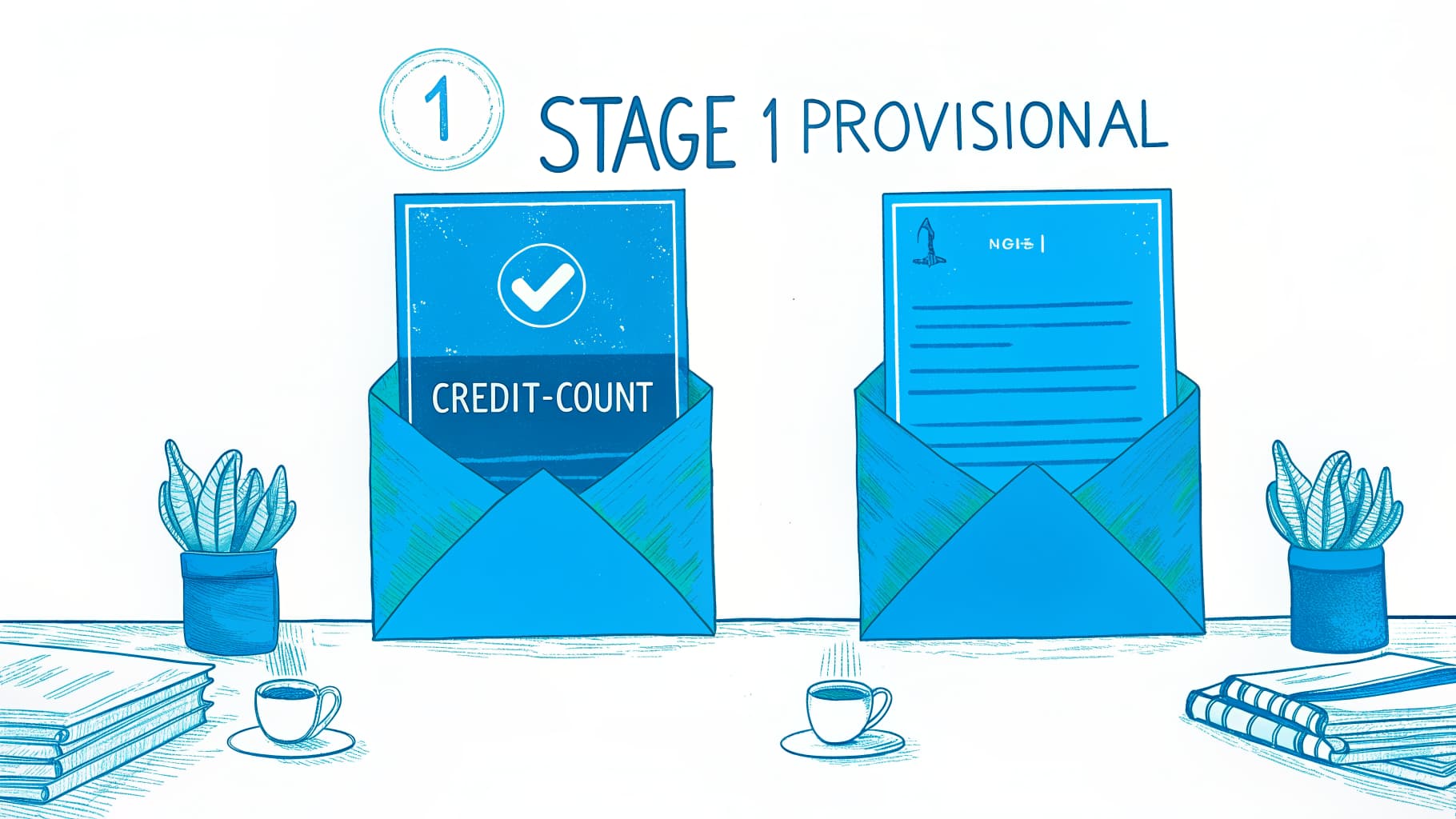
The two-stage credit evaluation process is one of the least-discussed traps in the entire transfer process. Stage one happens during admissions, when a registrar reviews self-reported or unofficial transcripts to produce a provisional credit award. Stage two happens after enrollment, when official transcripts go to individual academic departments for a course-by-course match against current degree requirements.
Those two reviews do not always produce the same number. The credit evaluation a student receives at admission is provisional, not final, meaning students are making an irreversible enrollment decision based on information that has not yet been confirmed. Compounding the problem is the conflicting guidance students receive while trying to clarify that provisional number before committing.
Transfer applicants routinely encounter contradictory information about credit caps during admissions. A front-desk admissions staff member may say there is no strict cap, while official policy documents suggest firm limits exist. Neither source resolves the discrepancy, and students are left planning around a figure that could shift in either direction after enrollment. Research on transfer student persistence shows that this kind of early uncertainty has downstream effects on whether students complete their degrees at all.
How the Official Transcript Review After Enrollment Can Quietly Change Your Standing
The frustrating part is there is rarely a warning. A student might receive a 60-credit preliminary award, enroll based on that count, and then discover after the semester starts that two courses were flagged as duplicates under the receiving school's internal policies, dropping the award to 51 credits. That is not a hypothetical; it is a pattern that repeats across schools and majors.
Students who send emails asking about official transcript evaluation during the admissions stage frequently receive no reply at all, leaving them to plan around a number that was never guaranteed. The silence is not a bureaucratic anomaly; it is a structural reality of how admissions offices are staffed relative to the volume of transfer inquiries they receive. This is precisely where a tool like Transfermatic's Articulation Requirement Matching feature changes the equation.
Rather than waiting on an email that may never arrive, students can compare course equivalencies across multiple target universities and majors quickly, before making any enrollment commitment. Knowing how your completed coursework maps to a specific school's requirements, in concrete terms, is a sharper foundation for decision-making than any provisional letter.
The Petition Process - How to Fight Back When a Course Isn't Automatically Matched
A credit petition, sometimes called a course substitution request, lets you ask a department to manually review a course that wasn't automatically matched. The strongest petitions include the original course syllabus, a catalog description, and a written argument connecting the course content to the equivalent requirement. Studies on transfer outcomes consistently link early, accurate planning to higher rates of degree completion, and petitions filed with complete documentation perform better than those relying on course titles alone.
This process works more often than students expect, but it requires knowing a mismatch exists before the add/drop window closes. That timing constraint is where Transfermatic's Transfer Roadmap Planning is most valuable. Within minutes of completing the intake setup, a student receives a personalized semester-by-semester transfer plan built around their target school and major.
The plan is designed to surface hidden prerequisites and off-path risks before a student registers for the wrong course, not after the semester has already started and a petition is the only option left. The feature is most beneficial when a student is at risk of taking off-path courses or is considering changing their major or target school mid-transfer, because plan regeneration can reflect those changes immediately rather than forcing a student to reconstruct their schedule manually.
What to Submit With Your Application to Protect Your Preliminary Credit Award
Articulation agreements are updated on academic-year cycles, meaning a fall and spring applicant from the same community college can be evaluated under different versions. A course pre-approved for a specific requirement in a fall articulation agreement may carry a different classification in the updated spring version, which is why students applying in the spring should verify the current agreement directly with the receiving department rather than relying on documentation they reviewed months earlier. Transfer persistence research identifies this kind of plan drift, where a student's expected path shifts due to policy changes they were never notified about, as a significant factor in delayed completion.
Transfermatic's Articulation Requirement Matching is built for exactly this scenario. Students deciding between multiple target universities or majors can compare how the same completed coursework is classified under different, current articulation agreements, catching version-cycle discrepancies before they become enrollment surprises. Pair that with Registration Deadline Reminders to ensure submissions reach the right departments before evaluation windows close, and students are no longer relying on documentation that may already be a semester out of date.
The Financial Cost of Lost Credits: and How to Avoid Paying for the Same Class Twice
The common assumption among students planning to transfer to a 4-year university is that if they can confirm a course "transfers," they are good, they just need to find the right list and follow it. But rejected transfer credits feel like a bureaucratic inconvenience until you do the math. The real cost is not just repeating a class. It is paying for an entire extra semester, watching your financial aid situation shift underneath you, and delaying the full-time income you were counting on to make the degree worth it in the first place.

What One Extra Semester Actually Costs in Dollars, Not Just Time
At a four-year public university, one extra semester of tuition, fees, and living expenses runs roughly $15,000 to $20,000 when you add housing, food, and transportation to direct tuition costs, according to the College Board's 2024 Trends in College Pricing data. That figure does not include the income you are not earning. Delaying a bachelor's degree by even one semester can reduce lifetime earnings by tens of thousands of dollars, because workforce entry is pushed back and early-career compounding never starts on time.
For a student already stretching every dollar, that is not an abstract risk. It is a concrete financial event. This is exactly why one of the sharpest things a transfer student can do is avoid taking unnecessary or non-transferable courses in the first place, not as a vague piece of advice, but as a measurable financial defense.
Every unit that does not count toward your degree at the destination school is a unit you paid for twice. Transfermatic is built around that principle: within minutes of completing an intake and setup, a student receives a personalized semester-by-semester transfer plan, generated through Articulation Requirement Matching, that maps each course they plan to take directly to a specific degree requirement at their target university. The plan is designed to be revisited each semester during course selection, so the course list stays aligned as requirements and articulation agreements change.
How Rejected Credits Quietly Trigger Financial Aid SAP Violations
Satisfactory Academic Progress (SAP) rules require that a student complete a minimum percentage of attempted credits each term to keep their financial aid. When a rejected or misapplied transfer credit gets counted as "attempted" but does not count toward your degree, your completion rate drops. Cross that threshold, and your aid gets suspended.
The student who retakes ECON 101 because it posted as a free elective instead of a major requirement is not just paying twice for the same class. They may be doing it without the aid they were depending on to finish at all. Students who lack access to frequent, personalized counselor appointments, or who are weighing the cost of private advising services against what they can afford, are the ones most exposed to this risk.
A counselor seen once a semester cannot catch a misaligned course in real time. Transfermatic's automatic schedule creation and plan regeneration features exist specifically to fill that gap: when a course becomes unavailable or a student's circumstances change, the plan updates rather than leaving the student to navigate the articulation system alone between advising appointments.
The Same Credits That Got Rejected Could Often Have Been Protected Before Enrollment
The window to protect your credits is before you register, not after you have already paid. Together, these two steps are the closest thing the transfer system offers to a guarantee, and both are available to any student who takes the time to build them before the semester starts:
- Getting written confirmation from the target university's department, not just a counselor's verbal assurance
- Building a course map that tracks which requirement each class satisfies
Transfermatic's Transfer Roadmap Planning is most valuable precisely at this moment: in the early semesters of community college, when a student has a target school or major in mind but has not yet locked in a course sequence. For students deciding between multiple target universities or majors, the Articulation Requirement Matching feature lets them compare course equivalencies across schools quickly, so the decision of where to transfer is informed by which path wastes the fewest credits, not just which school has the most appealing name.
Registration deadline reminders and a centralized scholarship finder round out the planning layer, keeping students from losing ground to administrative timing as much as to academic mismatches.
Stop Guessing Which Credits Count - Build a Plan That Actually Gets You There
Three variables have to line up at exactly the same time for a transfer plan to actually work: your target school, your intended major, and the semester you plan to apply. Miss the connection between any two of them, and a course that technically "transfers" still won't count toward your degree.

Why Articulation Agreements Don't Answer the Question Transfer Students Are Actually Asking
"Students have no clear understanding of which academic path (community college vs. 4-year university) actually counts toward their long-term goals, leading to costly guessing and risky decisions."
The transfer system was built around institutions, not students. According to the Community College Research Center, the information and advising infrastructure required to build a complete, accurate transfer plan is decentralized and rarely integrated in a way that serves one student's specific goal. That structural gap shows up in a pattern we see constantly: students have no clear understanding of which academic path, community college versus four-year university, actually counts toward their long-term goals, so they make expensive guesses. They enroll in courses that satisfy general education somewhere but do nothing for their intended major.
They discover mid-sequence that AP or CLEP credits they assumed would apply don't count the way they expected, and suddenly their timeline is a semester or a year longer than it needed to be. Counselors give advice in good faith, but California community college counselors carry caseloads of roughly 1,000 students per counselor, as documented by the Community College Research Center. That ratio is not anyone's fault, it is simply how the system was built, and it is why even diligent students end up with credits that go nowhere.
The Three Variables That Must Align Simultaneously, School, Major, and Timeline
A course can satisfy general education at one school and count for nothing toward a specific major at another. Add a semester variable, and articulation agreements that were current when you enrolled may have changed by the time you apply. Research consistently finds that the average transfer student loses a striking share of their credits, but that figure obscures a wide range of individual outcomes.
Students who build a major-specific plan before registering, confirm courses in writing with the receiving department, and track agreement updates each semester consistently land closer to the protected end of that range. This is exactly the gap Transfermatic's Transfer Roadmap Planning is designed to close. Most beneficial when a student is in the early semesters of community college and already has a target school or major in mind, it produces a personalized, semester-by-semester transfer plan, within minutes of completing an intake, that maps precisely which courses at your community college will count toward your intended major at your target university.
The Articulation Requirement Matching feature is especially useful when you're deciding between multiple target schools or majors and need to compare course equivalencies quickly, so you're not left guessing which path is actually shorter or cheaper. Because articulation agreements change, the plan is designed to be revisited each semester during course selection, and plan regeneration keeps your roadmap current rather than frozen at the moment you first built it. Registration deadline reminders surface the right action at the right time, so a calendar gap never quietly closes a door.
The result is a single, centralized answer to the question the advising infrastructure was never built to give you: exactly which classes to take, in what order, so you get to your target school on time without paying for credits that won't count.
Next steps
If your completed coursework keeps landing in the wrong category at the wrong school, the path forward starts with knowing how a course performs against actual degree requirements before you register, not after. Start with our best transfer planner for community college students.
The credit evaluation a student receives at admission is provisional, and the final binding review happens at the departmental level after enrollment, when the commitment is already irreversible. That means the 43% average credit loss statistic is not spread evenly across all students: it concentrates predictably among students who planned without major-specific, school-specific alignment, which is precisely the group with the least financial room to absorb an extra semester. Together, those two realities point to one concrete action: building a course map locked to your specific major and target school before you register for anything.
Start with Transfermatic to get a personalized, semester-by-semester plan built around your actual major requirements at your actual target school. The plan is revisited each semester as articulation agreements change, so you are not navigating on documentation that is already a cycle out of date.
Frequently Asked Questions
Which credits typically do not transfer?
Remedial and sub-100-level courses are almost never counted toward degree credit, and courses with grades of D or below are rejected at most universities even if the course itself would otherwise transfer. Courses from nationally accredited schools are also routinely rejected outright, regardless of grade or content, and courses that have no direct equivalent at the receiving school often land as unspecified electives that satisfy no requirement.
How many credits actually transfer successfully?
On average, transfer students lose 43% of their credits when moving from a community college to a four-year university, according to a 2021 analysis published by Journalist's Resource. That loss isn't caused by academic failure; it reflects a credit evaluation process most students don't know exists until it's already happened.
If a course shows up as "transferable," does that mean it counts toward my major?
No, "transferable" and "counts toward your major" are two separate outcomes decided by two different offices using different criteria. A course can be accepted by the registrar and posted to your transcript and still be coded as a free elective that satisfies no requirement in your declared major, because the department controls what counts toward graduation, not the admissions or registrar's office.
Do old college credits still transfer if the articulation agreement has changed since I took the course?
Not necessarily. Courses taken before an articulation agreement was updated may no longer match, even if they matched at the time you enrolled. This is one of four structural problems the post identifies as common causes of credit loss at the articulation matching stage.
Does completing a statewide transfer pathway like IGETC or an ADT protect all of my credits?
Only partially. Completing California's IGETC will typically cause a UC or CSU campus to waive lower-division general education requirements, and an Associate Degree for Transfer in Business guarantees junior standing at a CSU campus, but neither pathway covers major preparation courses. Those are governed by school-specific articulation agreements that each campus negotiates independently, so two students with identical transcripts can have very different outcomes depending on which school and department reviewed their file.