Most transfer students lose credits, time, and money to mistakes that feel invisible until it's too late. When you're transferring from college to university, these 13 predictable traps are built into the system. Here's how to avoid every one.
The gap between feeling on track and actually being on track is where most transfer journeys quietly fall apart. The common assumption is that the transfer system is complex, but as long as you follow the official process and ask for help when you're confused, you'll be fine.
Planning to transfer and transferring on time are not the same thing, and the distance between them is almost never visible from the inside. Students accumulate credits, maintain their GPA, and check the right boxes, while silently building a course history that doesn't line up with what their target university actually requires for their specific major.

The misalignment only surfaces late, when reversing it costs real time and real money. Transfer students often lose a significant share of their earned credits when moving from a community college to a four-year university. At 60 credits earned, that can mean a substantial number of credits that simply don't count.
The warning never comes in advance because no one in the advising chain is responsible for catching the mismatch before it happens. Articulation agreements and major-specific requirements exist to protect institutional standards, not to give students a clear path forward, a structural reality the CCRC's 2024 transfer tracking research confirms. These mistakes aren't random. They follow a pattern, and that pattern is almost entirely a product of how the transfer system was built.
68% of transfer students miss their two-year timeline
Key takeaways
- Only 16% of transfer-intending community college students earn a bachelor's degree within six years, not a motivation problem, a navigation problem.
- Over 68% of students who plan to transfer in two years miss that timeline, most of them blindsided by a credit evaluation they never saw coming.
- The mistakes that derail transfers aren't random, they're structural, predictable, and baked into a system designed for administrative coordination, not student success.
- Taking the wrong classes, missing articulation deadlines, and applying to the wrong schools in the wrong order are the specific traps that turn a two-year plan into a costly third year.
- Counselors and articulation tables give you information; they don't give you a sequenced, school-specific plan, and that gap is where most timelines collapse.
- Transfermatic closes that gap with personalized transfer roadmaps that map out exactly which classes count, which deadlines matter, and which path gets you to your target university without wasted semesters.
Why These Transfer Mistakes Are So Easy to Make (And So Costly to Fix)
That institutional design, built to serve administrative coordination rather than individual navigation, is what makes the most common transfer mistakes so predictable. The assumption most students carry into the process is that complexity is manageable: follow the official steps, ask a counselor when something is unclear, and the system will carry you through. It won't, not reliably, and not because students fail to try. The errors that derail transfers happen reliably because the system was constructed around institutional needs, and knowing that is what makes them avoidable.

Counselor Caseloads Make Personalized Advice Structurally Impossible
According to the American School Counselor Association, the national average student-to-counselor ratio is 408 to 1, well above the recommended 250 to 1. The NACAC State-By-State Student-to-Counselor Ratio Report confirms that only 3 states meet that threshold. That means your counselor is simultaneously managing academic planning, crisis response, college advising, and administrative work for hundreds of students at once.
The result is generalized advice, not personalized guidance. A counselor can tell you which courses transfer broadly, but they rarely have the bandwidth to verify whether a specific course satisfies a department-level requirement at your exact target school for your specific major. That gap is where transfer planning errors quietly take root, and it falls disproportionately hard on students who don't have frequent, personalized counselor appointments to begin with, or who can't afford a private college advisor to fill the void.
This is precisely the structural problem Transfermatic is designed to address. Rather than replacing a counselor's judgment, it functions as a personalized, always-available alternative for the students who need it most: those navigating the process without reliable access to one-on-one advising. Within minutes of completing an intake, students receive a personalized semester-by-semester transfer plan built around their specific target school and major, the kind of articulation-aware, course-level specificity a counselor managing 400-plus students structurally cannot provide.
That plan is revisited each semester during course selection, and regenerated whenever circumstances change.
The System Offers No Real-Time Warning When Something Is Off
Articulation rules are school-specific, major-specific, and updated without notice. Students regularly discover this the hard way: a student with 20 prior courses may find only a fraction auto-approved weeks after submitting a transfer credit evaluation, leaving the rest in limbo with no clear timeline and no explanation of what will or won't count. That uncertainty isn't an edge case; it's a structural feature of how institutions process transfer credit.
And for students who are unclear on even the correct process for submitting credits in the first place, who default to searching online rather than knowing the official steps, that ambiguity compounds quickly. The risk is sharpest when credits originate from schools with non-standard accreditation. Credits earned at institutions like Full Sail, for example, may simply not transfer to traditional four-year universities at all, leaving students holding expensive, non-portable credentials with no path to apply them toward a degree.
These aren't mistakes that surface immediately; they surface a semester or two later, after tuition has already been spent. A first-generation transfer student working 30 hours a week while carrying a full course load has almost no spare time to cross-reference articulation databases, read department requirement pages, and track deadlines simultaneously. Missing one footnote in a course equivalency table can mean a semester of wasted tuition.
Transfermatic's Articulation Requirement Matching addresses this directly. It is most valuable precisely when a student is deciding between multiple target universities or majors and needs to compare course equivalencies quickly, before committing to a course that may not count. Paired with registration deadline reminders and automatic schedule creation, it closes the gap between what the official system communicates and what a student actually needs to know to transfer cleanly. Most transfer planning errors come from capacity, not carelessness, and removing the information burden is how you prevent them.
The 13 Community College Transfer Mistakes to Avoid in 2026
Predictable structural traps are exactly what that statistic exposes: only about 16% of transfer-intending community college students earn a bachelor's degree within six years. Not one in two, not one in three, one in six. The students who don't make it aren't the ones who stopped trying. They're the ones who trusted a process that was never designed to protect them from its own complexity. The 13 mistakes below are not character flaws. They are those same predictable traps, and every single one has a specific prevention step you can take before the damage is done.
The Intersegmental General Education Transfer Curriculum (IGETC), replaced by Cal-GETC for students transferring in fall 2025 and later, is a standardized set of general education courses that, when certified by your community college, satisfies lower-division general education requirements at most UC and CSU campuses. The critical word is "certified." Completing the courses is not enough.
Your community college must officially certify IGETC completion on your transcript before transfer. Students who skip this step arrive at their four-year school and are required to complete additional general education units they believed they had already finished. Prevention: request IGETC certification from your college's records office before your transfer application is submitted.
1. Skipping the Transfer Counselor Until It's Too Late
Many transfer students wait until their final semester to meet with a transfer counselor, only to discover missing prerequisites or misaligned coursework. Counselors map out multi-semester plans that align with specific four-year university requirements. The tradeoff: scheduling appointments early takes initiative, but students who skip this step routinely lose a full year of progress or miss competitive transfer windows entirely.
2. Misreading Assist.org Articulation Agreements as Infallible
Assist.org is the primary articulation tool for California community college transfers, but it contains documented errors and outdated agreements. Students who blindly trust its course equivalencies risk completing courses that don't actually satisfy transfer requirements. Always cross-verify articulation data with both your community college counselor and the receiving university's department directly before enrolling in any prerequisite course.
3. Failing to Complete IGETC Certification Before the Deadline
IGETC certification clears general education requirements at UC and CSU campuses, but students frequently miss submission deadlines or submit transcripts before the certification is processed. This forces students to retake GE courses at the four-year university, adding semesters and cost. The fix is simple but time-sensitive: request IGETC certification early and confirm your receiving institution has the updated transcript reflecting it.
4. Ignoring TAG Requirements Until the Application Window Closes
The Transfer Admission Guarantee program offers California community college students a guaranteed UC admission pathway, but it has strict eligibility windows, GPA thresholds, and course completion requirements. Students who discover TAG too late lose one of the most powerful transfer tools available. Missing the September submission window means waiting an entire additional year, making early awareness of TAG timelines a critical community college transfer mistake to avoid.
5. Listing the TAG Major Incorrectly on the Application
A surprisingly common TAG denial stems from students listing their TAG-eligible major as a secondary rather than primary major on their application. This clerical error invalidates the guarantee entirely. Students pursuing TAG must ensure the guaranteed major appears as their declared primary major on every application form. Double-checking this detail before submission takes minutes but prevents a denial that can cost an entire academic year.
6. Accumulating Withdrawals on Major Prerequisite Courses
Withdrawals on major prerequisite courses raise serious red flags for competitive transfer programs, even when they don't affect GPA. Multiple Ws signal inconsistency and lack of academic commitment to admissions reviewers. While Ws on general education courses are more forgivable, students should exhaust every resource, tutoring, office hours, reduced course loads, before withdrawing from any course directly tied to their intended transfer major.
7. Transferring Between Community Colleges to Reset GPA
Students with poor early academic records sometimes transfer to a new community college believing it resets their GPA for four-year applications. In reality, all transcripts from every institution attended must be submitted, and four-year universities calculate cumulative GPA across all colleges. This strategy wastes time, resets financial aid completion rates, and adds another institution to a transcript that may already raise questions. Grade forgiveness or academic renewal at your current school is almost always the better path.
8. Neglecting to Take the Right Lower-Division Major Prerequisites
Community college advisors sometimes guide students toward completing an associate degree without ensuring the coursework aligns with the specific lower-division requirements of the intended transfer major. Engineering students, for example, need Calculus I, II, III, differential equations, physics sequences, and chemistry before transferring as juniors. Completing the wrong courses means arriving at a four-year university as a de facto freshman in your major, adding one to two years of additional study.
9. Applying to Only One or Two Transfer Institutions
Transfer applicants who apply to only one or two schools dramatically increase their risk of having no viable pathway forward if denied. Unlike first-year applicants, transfer students often have narrow application windows and fewer second-chance options. Building a balanced list that includes reach schools, target schools, and guaranteed-admission safety options, including TAG-eligible campuses, protects against a single denial derailing an entire academic timeline.
10. Failing to Report All Colleges Attended on Applications
Students who attended multiple colleges before their current community college sometimes omit earlier institutions from transfer applications, hoping poor grades won't be discovered. This constitutes academic dishonesty and can result in rescinded admission or expulsion after enrollment. Every institution attended must be disclosed. Admissions offices routinely cross-reference records, and a discovered omission is far more damaging than any low grade from years prior.
11. Assuming Dual Enrollment Credits Will Transfer Automatically
High school students who complete dual enrollment courses often assume those credits will seamlessly transfer to their eventual four-year university. In practice, dual enrollment credit transfer is inconsistent and institution-dependent. Some universities accept them as elective credit only, others reject them outright, and articulation agreements rarely cover dual enrollment coursework explicitly. Students should verify dual enrollment credit acceptance with each target institution's registrar before counting those credits toward transfer requirements.
12. Not Completing the Minimum 60 UC-Transferable Units Before Applying
A foundational community college transfer mistake is applying to UC campuses without having completed or being on track to complete 60 UC-transferable semester units by the end of the spring term before transfer. Students sometimes receive incorrect guidance from counselors about which courses count as UC-transferable, leading to TAG denials and general application rejections. Verifying unit counts using official UC transferable course lists, not just a counselor's verbal confirmation, is essential.
13. Overlooking the Transfer Application Personal Statement as an Afterthought
Transfer applicants frequently underinvest in their personal statements, treating them as a formality after focusing heavily on GPA and prerequisites. For competitive institutions, the personal statement is where context for academic struggles, non-traditional backgrounds, and motivation for transfer is communicated. A compelling narrative about your community college journey, including obstacles overcome and clear academic purpose, can meaningfully differentiate an application in ways that GPA alone cannot accomplish.
Related Reading
- Transfer Student
- How To Make Friends As A Transfer Student
- How To Transfer From Community College
- Community College To Ivy League
- Community College Transfer Process
- College Transfer Guide
- How To Transfer Colleges
- Do Community College Credits Transfer
The Real Reason So Many Transfer Students End Up in a Costly Third Year
Most transfer students don't fall behind because they gave up or lost focus. They fall behind because the two-year timeline was never realistic given their actual course sequence, and nobody surfaced that reality until it was too late to fix it. This section breaks down why that gap between expectation and outcome is so predictable, and how building a semester-by-semester plan early in your community college journey is the only reliable way to avoid it.
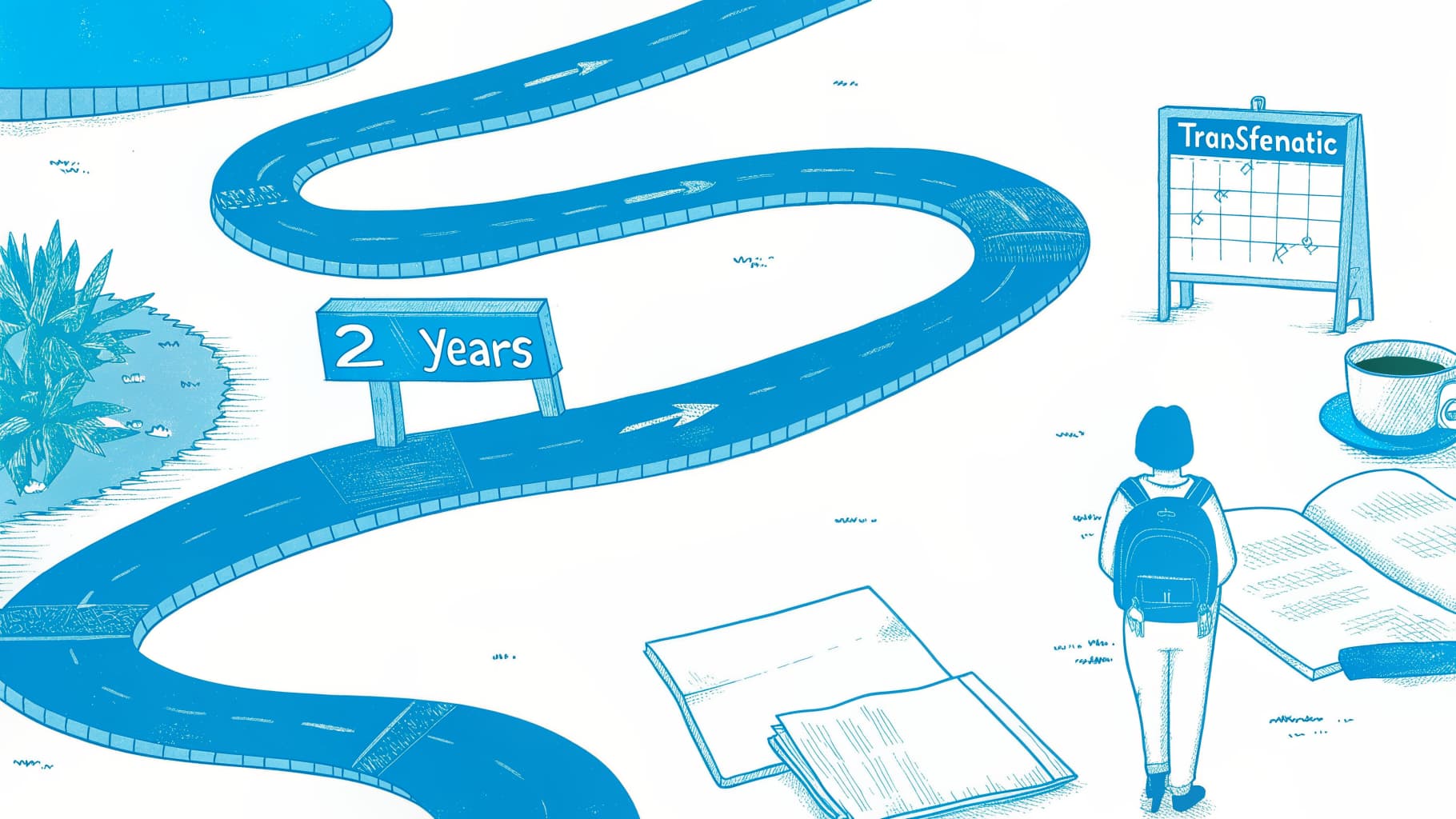
The "2-Year Transfer" Is a Myth for Most Students - What the Data Actually Shows
Over the same period reflected in that earlier figure, the trend becomes even clearer. That number isn't driven by students who stopped trying. It's driven by students who thought they were on track until a credit evaluation in their final semester proved otherwise. College transfer enrollment grew by 4.4% in fall 2024, meaning more students than ever are walking into this same trap.
What makes the two-year window especially unforgiving is what happens when foundational requirements pile up late. Transfer students who arrive at their target school with uncovered major prerequisites, or any core program requirements missed early, face a Year 2 course load with no breathing room: an all-major, no-elective grind with no margin for a single scheduling error. That compression isn't a character flaw.
It's the predictable result of a plan that was never built to surface hidden prerequisites before enrollment, when there was still time to act. The most effective intervention is a semester-by-semester transfer plan built at the start of a student's community college journey, not reconstructed after the damage is done. This is exactly where Transfermatic's Transfer Roadmap Planning is most beneficial: in the early semesters of community college, when a student has a target transfer school or major in mind.
Within minutes of completing an intake and setup, the tool generates a personalized semester-by-semester transfer plan through Articulation Requirement Matching, mapping each course not just to whether it transfers, but to whether it satisfies the exact requirements of the student's specific program at their specific target school.
How One Wrong Course Recommendation Silently Locks You Into a Third Year
The most damaging advising error isn't a course that fails to transfer. It's a course that transfers fine but lands as a general elective instead of fulfilling a specific major requirement at your target school. It only surfaces at credit evaluation, after you've already enrolled.
Because you believe you're on track, you stop auditing. One misaligned course compounds across semesters until a recoverable error becomes a locked-in third year. The students we work with who face this outcome share a common thread: the course looked right on a checklist, but no one modeled whether it satisfied the exact requirement at the exact school.
Transfermatic's Articulation Requirement Matching is built specifically to close that gap, it's most actionable when a student is deciding between multiple target universities or majors and needs to compare course equivalencies quickly, before a semester is spent on the wrong elective.
Why ASSIST.org and Generic Checklists Cannot Catch the Error That Costs You 12 Months
Transfer pathways are institution-specific and major-specific, as industry research documents. A course that satisfies a requirement at one university may count as nothing toward the equivalent program at another. Generic checklists cannot model that.
They tell you a course transfers; they cannot tell you whether it satisfies your exact major requirements at your exact target school. Transfermatic's Transfer Roadmap Planning is revisited each semester during course selection, not consulted once and forgotten. Automatic schedule creation and plan regeneration mean that when a prerequisite shifts, a course section fills, or a target school changes, the plan rebuilds around the new reality instead of leaving the student to reconcile the gap manually.
Registration deadline reminders close the final loop: a correct plan executed a week late can produce the same outcome as no plan at all.
The Hidden Price Tag of a Single Advising Mistake
One unplanned semester adds tens of thousands of dollars in tuition, room, and board, before accounting for delayed income. California's counselor-to-student ratio runs as high as 1 to 1,000, and transfer enrollment continues to climb, stretching that ratio further. The advising system was not built to catch individual prerequisite mismatches across every student's unique combination of school, major, and prior coursework. A personalized semester-by-semester plan, built at intake, matched to articulation requirements, and regenerated as circumstances change, is the structural correction that the ratio makes impossible to deliver at scale through human advising alone.
Related Reading
- Transferring From Community College To University
- Transfer Articulation
- When Is It Too Late To Transfer Colleges
- Is Community College Free In California
- Do Community College Credits Expire
Next steps
If your transfer plan feels solid on paper but you have no way to verify whether each course satisfies the exact requirement at your exact target school, the path forward starts with treating that uncertainty as the structural problem it actually is, not a personal oversight. The 68% of transfer students who miss their two-year window are not the ones who stopped trying. They are the ones who trusted a process that was never built to surface the course-level mismatch before it locked in. Start with our best transfer planner for community college students.
The counselor caseload reality means the guidance you receive is almost inevitably generalized, covering what transfers broadly rather than whether a specific course satisfies a department-level requirement at your specific program. That generalization means one misaligned course recommendation can silently reprogram your entire timeline, landing as a general elective instead of a major requirement and only surfacing at credit evaluation, after enrollment, when the damage is already done. Together, those two realities point to one corrective action: a semester-by-semester plan built around your exact school and major, consulted before each course decision, not after.
Start with Transfermatic. After a short intake, you get a personalized roadmap matched to your specific target school and major, so every course decision you make from here forward is checked against the actual requirements that determine whether you transfer on time.
Frequently Asked Questions
What happens if I apply to only highly competitive schools and get denied everywhere?
A denial cycle from only applying to reach schools costs you a full application year. The post recommends including at least two schools where your GPA and course completion clearly meet the published transfer requirements so you have a realistic path forward.
Can I just complete the IGETC courses and assume I'm done, or is there an extra step?
Completing the courses is not enough, your community college must officially certify IGETC completion on your transcript before you transfer. Students who skip the certification step arrive at their four-year school and are required to complete additional general education units they believed they had already finished. Request the certification from your college's records office before submitting your transfer application.
If I'm considering a few different majors, when do I actually need to commit to one?
The post recommends declaring a target school and major by the end of your first semester, even if that choice evolves later. Articulation agreements, TAG eligibility, and prerequisite chains are all school-specific, so a generic course plan built without a target school and major in mind is functionally a plan for no school in particular.
I finished all my required courses, why might I still not be considered a true junior at my new school?
Credits "transferring" and credits "counting toward your major" are two entirely different things. Many transfer students lose meaningful credit because their completed courses satisfy general elective requirements at the receiving institution but do not fulfill specific major prerequisites, so you can arrive as a junior on paper but functionally need to repeat lower-division coursework.