Transfer

    AP Scores That Don't Count (And Which Colleges Take Them)

    Tyler Maher
    By Tyler Maher · Founder & CEO
    3 min read · Published
    Logos of universities with differing AP credit policies including Texas, UCLA, USC, Ohio State, Harvard, and Georgia Tech

    You sat the exam, you got the score, and then the college shrugged. Some AP exams simply don't convert into credit at a lot of universities, and these five are the usual suspects.
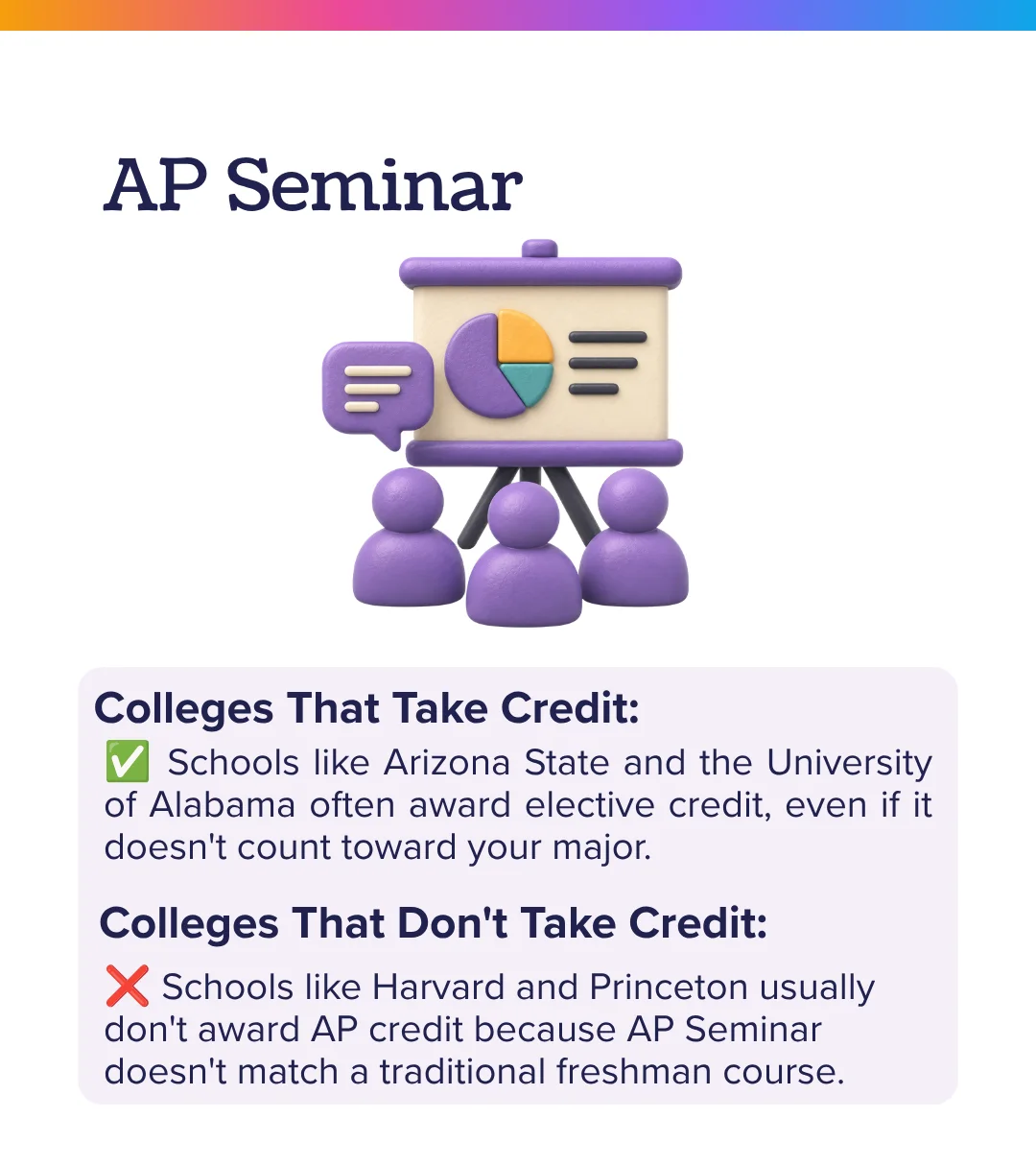
    AP Seminar credit: Arizona State and Alabama often award elective credit, Harvard and Princeton usually do not
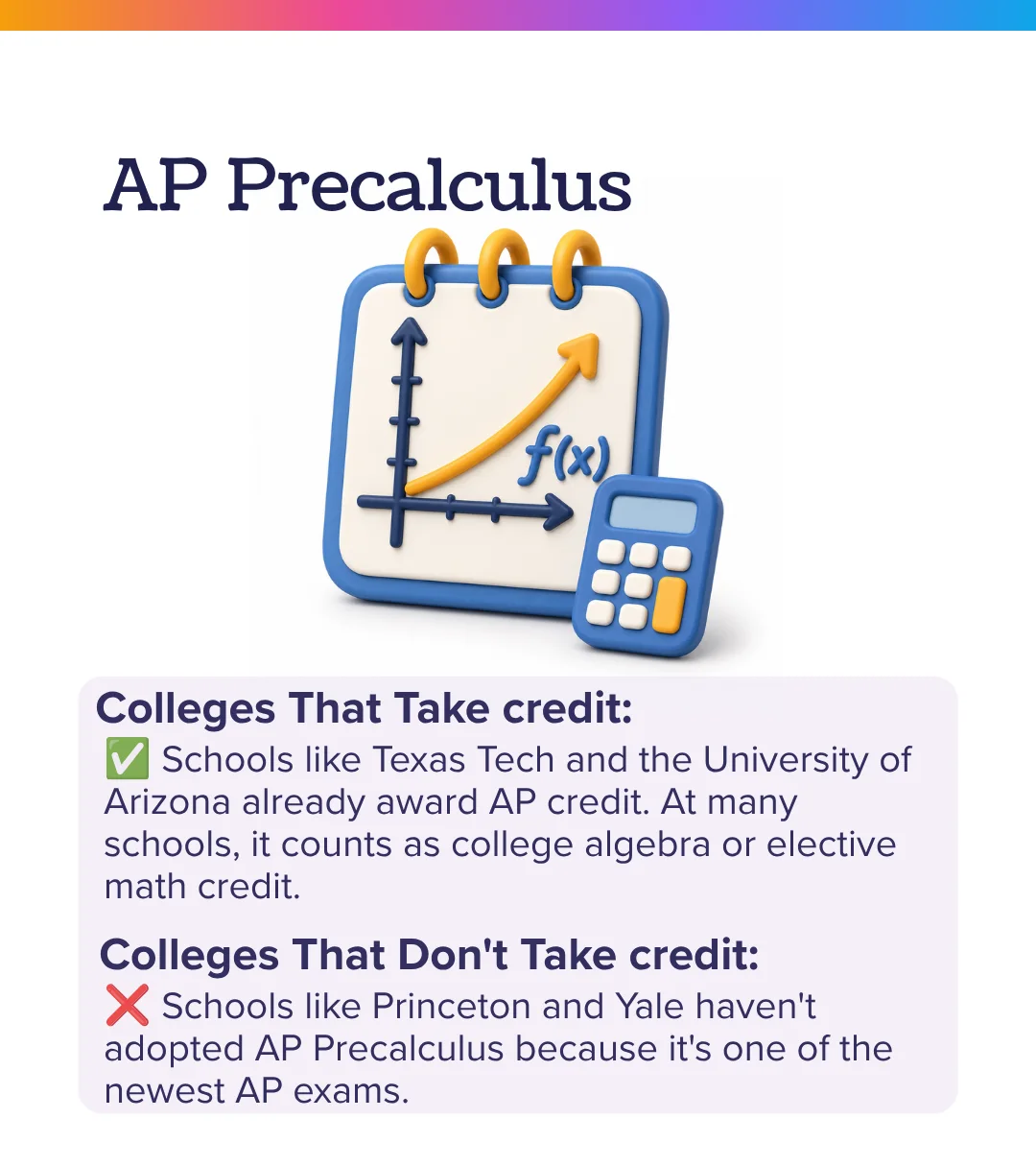
    AP Precalculus credit: Texas Tech and Arizona award credit, Princeton and Yale have not adopted it because it is a new exam
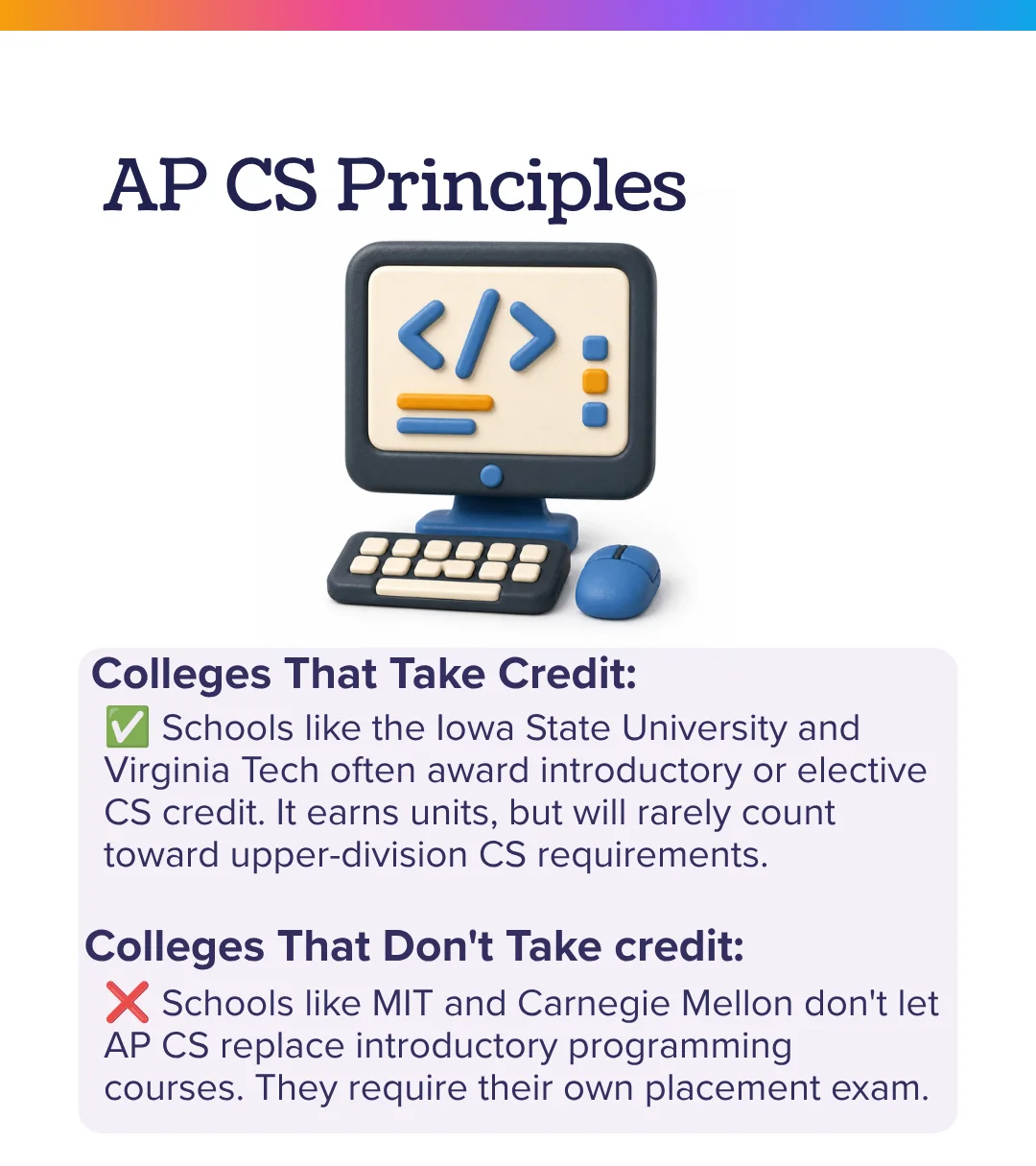
    AP Computer Science Principles credit: Iowa State and Virginia Tech award intro or elective CS credit, MIT and Carnegie Mellon require their own placement exam
    AP Environmental Science credit: Colorado State and Georgia award 3 to 4 credits, MIT and Princeton rarely award major credit
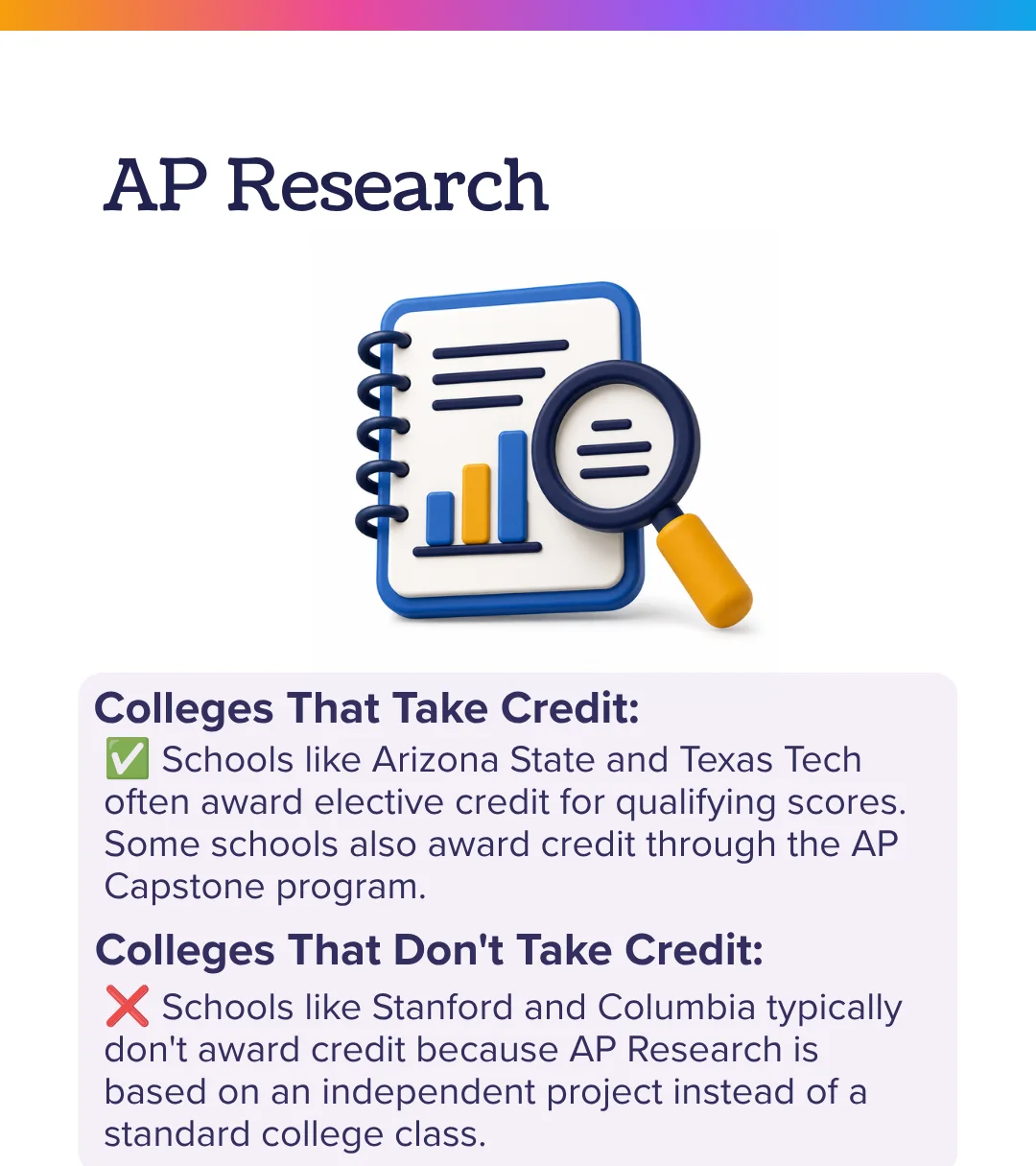
    AP Research credit: Arizona State and Texas Tech often award elective credit, Stanford and Columbia typically do not

    The five AP exams that often don't count

    AP examOften accepted atOften refused atWhy
    AP SeminarArizona State, AlabamaHarvard, PrincetonNo matching freshman course
    AP PrecalculusTexas Tech, ArizonaPrinceton, YaleOne of the newest AP exams
    AP CS PrinciplesIowa State, Virginia TechMIT, Carnegie MellonThey use their own placement exam
    AP Environmental ScienceColorado State, GeorgiaMIT, PrincetonCredit given as elective, not major
    AP ResearchArizona State, Texas TechStanford, ColumbiaIndependent project, not a standard class
    Representative policies. Every university publishes its own AP chart, and they change — always check your specific campus.
    Elective ≠ major
    The trap: credit that counts toward units but not toward your degree requirements

    Read the fine print: elective credit is not major credit

    The pattern across all five is the same. Big public universities tend to say yes but file the credit as a general elective. The units land on your transcript, your degree requirements don't move, and you still take the real course. Selective private universities more often decline outright, which is at least honest about it.

    That distinction is the whole thing. Units you can't apply are the same trap that makes students pile up about 90 units when only 60 transfer.

    Why transfer credit is the safer bet

    Here's what makes community college coursework different: it isn't discretionary. When a course sits on an articulation agreement, the university has already committed in writing that it satisfies a specific requirement. No chart to interpret, no elective limbo. That's why a semester of real college calculus usually beats a 5 on an AP exam the school hasn't adopted yet — and why credits that expire or fail to apply are worth checking before you enroll, not after.

    Skip the guessing on what counts.

    Put in your community college and your university. That's it.

    Get My Transfer Plan

    Bottom line

    Five AP exams routinely fail to convert: Seminar, Research, Precalculus, CS Principles, and Environmental Science. Public universities usually give you elective units; selective ones often give you nothing. Check your target's AP chart before you count on any of it, then line up coursework that's guaranteed to count instead.

    Related: see the classes your major needs at your college · what an articulation agreement is · do community college credits expire? · the three transfer application mistakes that get students rejected

    Frequently asked questions

    Which AP exams do colleges usually not give credit for?

    AP Seminar, AP Research, AP Precalculus, AP Computer Science Principles, and AP Environmental Science are the five most commonly refused, because they either do not match a standard freshman course or are too new.

    Do selective colleges accept AP credit?

    Less often than public universities. Harvard, Princeton, Stanford, MIT, and Columbia frequently decline these five, while Arizona State, Texas Tech, Iowa State, Colorado State, and the University of Alabama commonly award at least elective credit.

    Is community college credit better than AP credit?

    Usually yes for transfer purposes. A community college course that appears on an articulation agreement is guaranteed to transfer for a specific requirement, while AP credit is granted at each university's discretion and often lands as an unassigned elective.

    How do I check if my AP score counts?

    Look up the specific university's AP credit chart before you rely on it, because policies differ by campus and by exam. Never assume a 5 converts into major credit.

    Tyler Maher

    Written by

    Tyler Maher

    Founder & CEO

    Tyler is the founder and CEO of Transfermatic. He started the company to make California's transfer system easier to navigate, and writes here because the rules around ASSIST, Cal-GETC, and UC and CSU admissions are genuinely confusing and badly explained almost everywhere else.

    Keep reading

    Build your transfer plan

    Personalized, semester-by-semester, verified from ASSIST data. Free to start.

    Get My Transfer Plan