The schools with the strongest alumni networks are not the ones you would guess. The Princeton Review's ranking is topped by Clemson, Washington State, and Georgia — and several of them admit most people who apply.
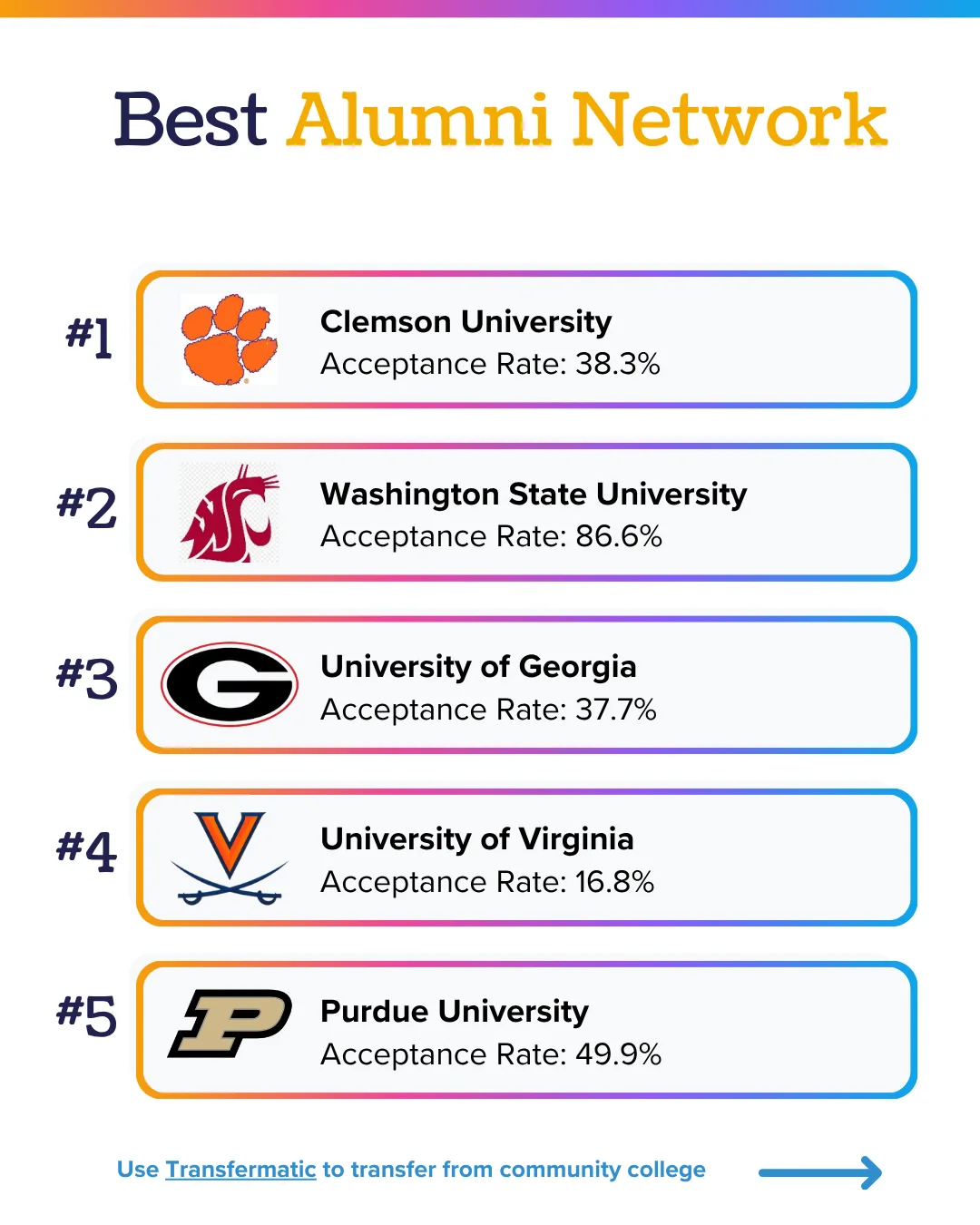
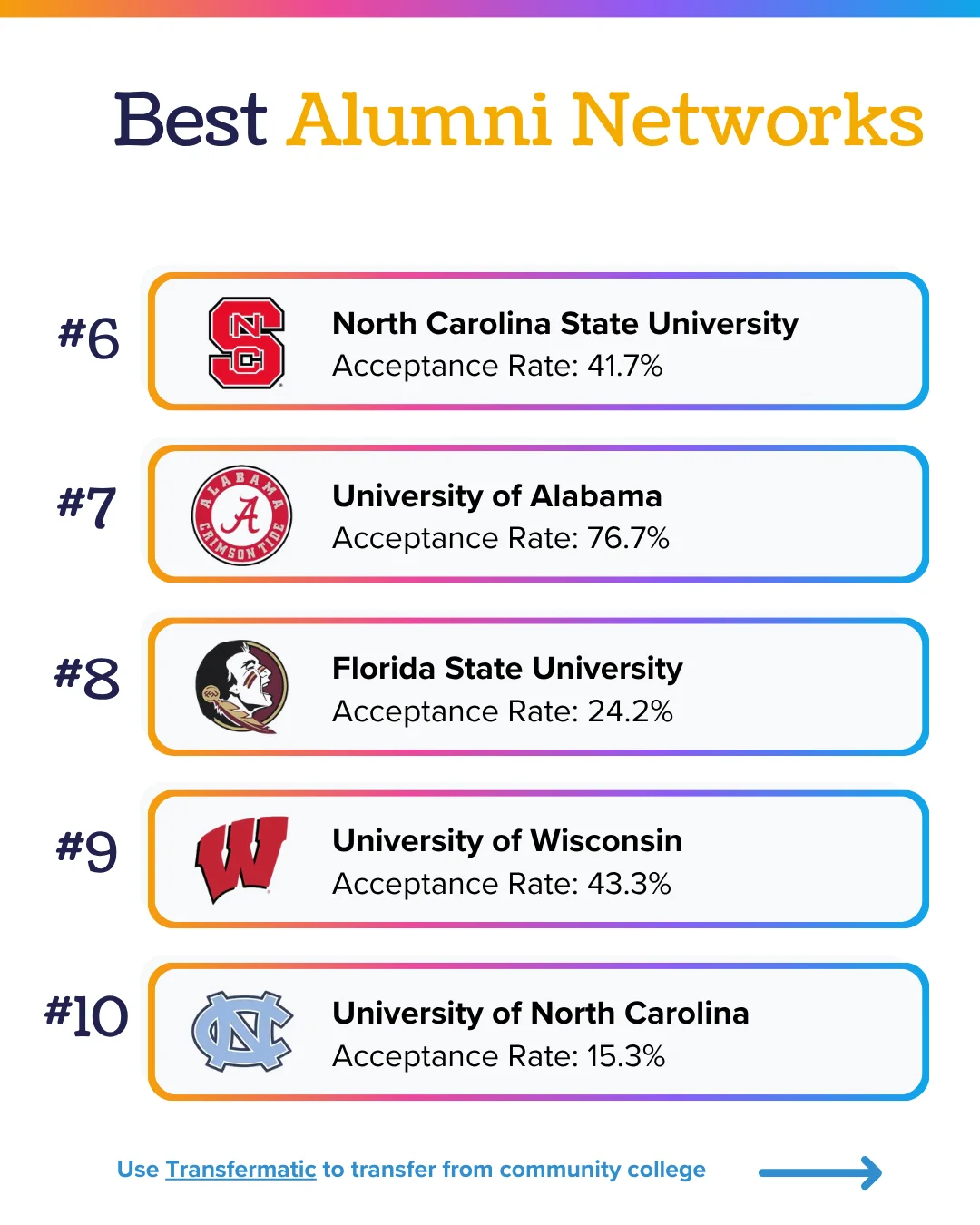
The best alumni networks, ranked
| # | School | Acceptance rate |
|---|---|---|
| 1 | Clemson | 38.3% |
| 2 | Washington State | 86.6% |
| 3 | University of Georgia | 37.7% |
| 4 | University of Virginia | 16.8% |
| 5 | Purdue | 49.9% |
| 6 | NC State | 41.7% |
| 7 | University of Alabama | 76.7% |
| 8 | Florida State | 24.2% |
| 9 | Wisconsin | 43.3% |
| 10 | UNC Chapel Hill | 15.3% |
| 11 | Ohio State | — |
| 12 | James Madison | — |
| 13 | William & Mary | — |
| 14 | UT Austin | — |
| 15 | Baruch College | — |
Why state schools win this and the Ivies don't
Three things make a network actually work, and none of them is prestige.
Size. A graduating class of 8,000 beats one of 1,600 every year, forever. There are simply more people to find.
Loyalty. Football Saturdays, marching bands, and thirty-year season tickets build the reflex that makes a stranger answer your message. Clemson and Alabama run on this.
Density. Purdue engineers cluster in specific firms. Baruch feeds Wall Street from Manhattan. A concentrated network in your industry beats a famous one scattered everywhere.
“Your diploma doesn't say how you got in. Neither does the alumni directory.”
Transfer students get all of it
This is the part worth internalizing: alumni access is not tiered. You graduate with the same degree, land in the same directory, and get the same reply rate as someone who spent four years there. Nobody asks which year you arrived.
So the play is simple. Pick a school whose network is dense where you want to work, get in through the door that is actually open, and start using the directory the week you arrive. Several schools on this list admit most applicants — and for the ones that don't, the transfer door is usually wider than the freshman one.
Pick the network, then get in the door.
Put in your community college and your dream university. That's it.
Get My Transfer PlanBottom line
The best alumni networks belong to big loyal state schools, not the most selective ones — and half of this list would take you. Find where your industry clusters, line up the classes that get you there, and use the directory like it is yours. It is.
Related: see the classes your major needs at your college · the most overlooked college majors · universities with the best ROI · the top 15 public universities ranked